No desktop GIS. No manual data prep. No file wrangling.
Automated watershed modeling — from a map click to a SWAT+ model
Choose a watershed on a map — a USGS gauge, a HUC12 outlet, a whole HUC8, or a single 30 m catchment for site-scale work. The pipeline delineates from NHDPlus HR, assembles 3DEP terrain, gSSURGO soils, NLCD land cover, and PRISM + NSRDB climate, and delivers editable, calibratable SWAT+ model files.
Every build auto-runs a 10-year verification simulation and a SWAT+ Check screening report, so you see how the model behaves before you invest in calibration.
- Gauge · HUC12 · HUC8 · 30 m site
- NHDPlus HR delineation
- 10-yr verification run included
- Editable model files, not reports
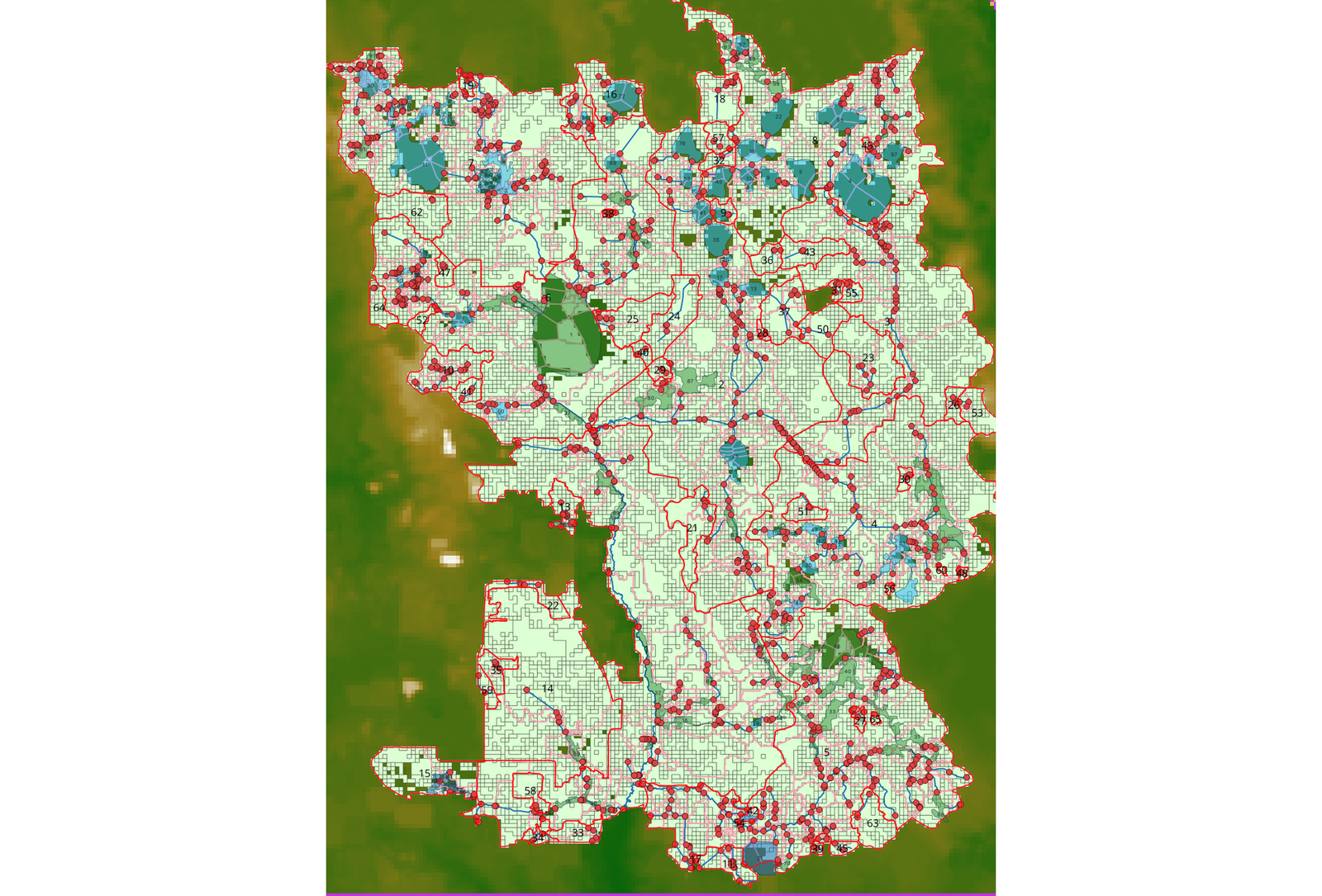
SWATGenX automates the part of watershed modeling that eats weeks: acquiring and clipping national datasets, repairing hydrography, delineating channels and HRUs, and assembling the QSWAT+ / SWAT+ Editor project. Every order runs the same versioned national pipeline on cloud infrastructure, so a 50-basin study gets 50 models built by identical rules — comparable, auditable, and reproducible.
Screen basins in the Watershed Explorer, order in one click or through the developer API, and watch each build stage live. Finished models ship as the actual editable, calibratable files — QSWAT+ project, SWAT+ Editor database, TxtInOut, and NetCDF outputs — not a locked report. The public example-models catalog publishes observed generation times and calibration results, and AI agents can search, order, and download models directly through the public MCP server.
Hydrologists, researchers, and instructors who need consistent models across many basins — regional and multi-state assessments, method studies, and anyone who would rather spend the week reviewing a finished model than assembling one.
Manual SWAT+ setup versus the automated SWATGenX workflow
The manual path: acquire and clip PRISM, NLCD, gSSURGO, DEM, and hydrography; repair topology; run QSWAT+ interactively; export through SWAT+ Editor — then repeat every step, identically, for the next basin, and the next.
The SWATGenX path: select a gauge, HUC12 outlet, or HUC8 on the map; the pipeline clips the national data, delineates on the NHDPlus HR stream network (or with TauDEM, if you choose it), assembles the QSWAT+ / SWAT+ Editor project in the cloud, and delivers a complete package you can compare against the public example catalog.
NHDPlus HR carries roughly an order of magnitude more national flowlines than NHDPlus V2. At that resolution every manual step multiplies — which is exactly why the pipeline, not a person, should be doing the assembly.
Explore a real aquifer in 3D — live
This is a real SWATGenX model running on this page: a six-layer MODFLOW 6 aquifer beneath a Michigan headwater catchment, built automatically from state well records. Drag to orbit, peel the layers, slice top-down, and hover any cell for its hydraulic conductivity. The scene is the model's MODFLOW_250m configuration, built 2026-06-20.
Start now
Data backbone (citations & resolutions):
- 25,000+ USGS stations — live context via USGS Water Services (instantaneous values often ~15-minute; see USGS for provisional data caveats)
- NHDPlus HR — built from 1:24,000 NHD, 10 m 3DEP, and WBD; USGS cites on the order of ~27 million flowlines vs ~3 million in NHDPlus V2 (USGS NHDPlus HR)
- PRISM gridded climate (~4 km cells; PRISM defines a “day” as 24h ending 12:00 GMT); NLCD land cover 30 m; gSSURGO soils (gridded SSURGO per NRCS); NSRDB solar/meteorology nominally ~4 km (≈0.038°), 30-minute series — SWATGenX may resample/regrid for operations; see methodology for lineage
Data provenance & methodology — citations, native vs operational resolution notes, and limitations.
Consistency is the point
One versioned pipeline produces every model: the same preprocessing rules, the same metadata, the same package layout. That is what makes a multi-basin study comparable basin to basin — and it is why the example-models catalog can publish generation times and calibration metrics for every model it lists. Your judgment goes where it belongs: calibration, scenarios, and sign-off.
What the automation does for you
- Removes the manual steps: dataset download and clipping, topology repair, interactive QSWAT+ sessions, and hand-built SWAT+ Editor databases
- Delineates from NHDPlus HR — roughly an order of magnitude more national flowlines than older hydrography — or from the DEM with TauDEM when you choose it
- Runs every model through the same versioned pipeline, then auto-chains a 10-year verification simulation and a SWAT+ Check screening report so you see model behavior before calibrating
- Leaves you the scientific work: reviewing outputs, calibrating (cloud calibration available per model), and judging fitness for your question
Automation removes setup labor and improves repeatability; it does not replace scientific review. Datasets, delineation source, and package contents may vary by watershed, workflow, and pipeline version — read run metadata and cited methodology before formal use.
Model Creation API examples (Jupyter + Python): GitHub.