Surface water and groundwater, one simulation
SWAT+ watershed simulation platform for the U.S.
Build SWAT+ simulation models for scenario analysis and research — or add a steady-state MODFLOW 6 groundwater model. Daily two-way SWAT+/MODFLOW 6 coupling, exchanging water between the land surface, channels and a full 3D groundwater grid, is research work.
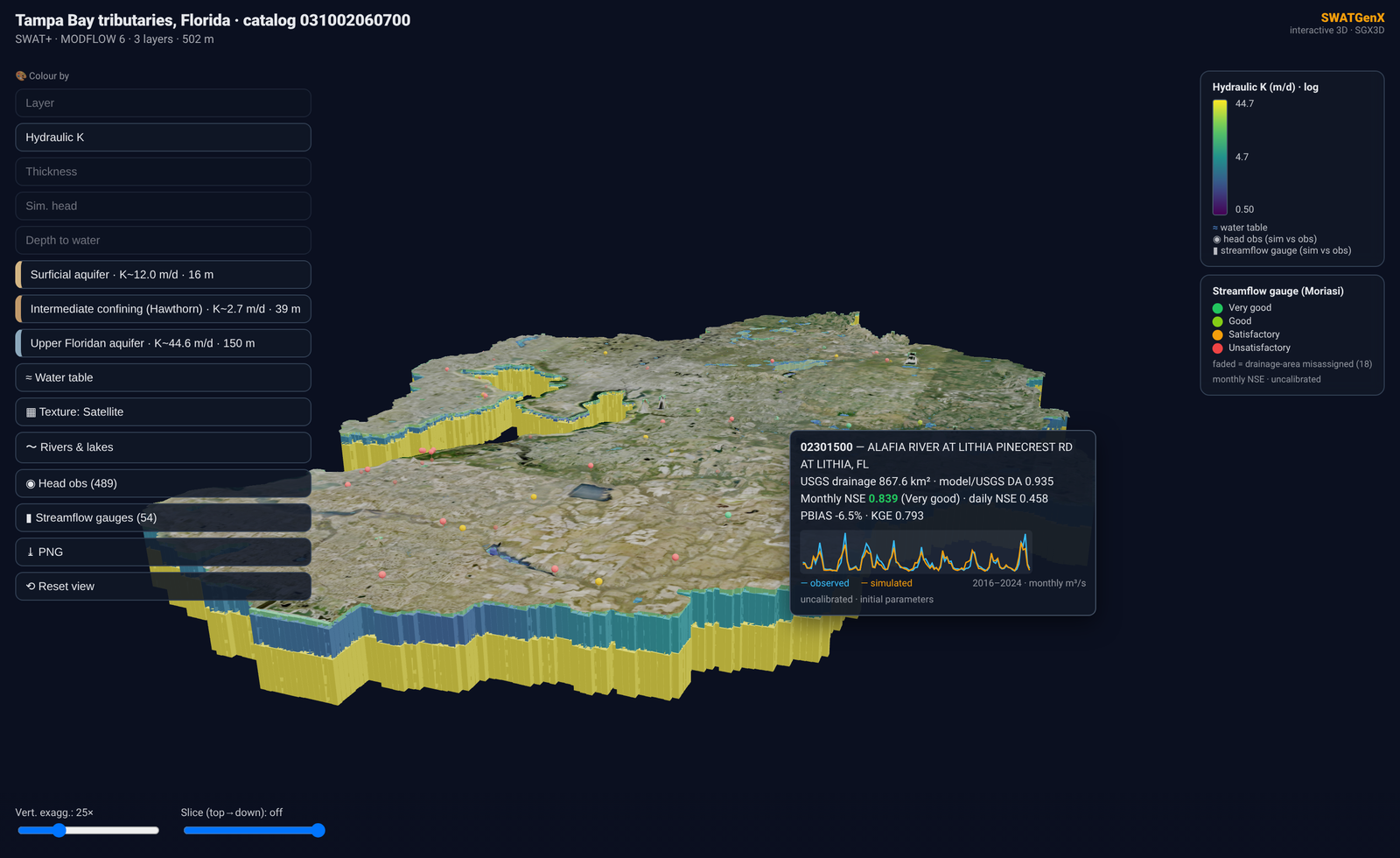
The 3D view below is live — an actual coupled model rendered in the browser from real simulation output, not an illustration.
- Scenario & what-if analysis
- SWAT+ ↔ MODFLOW 6 (two-way)
- Live 3D model viewer
- Calibrated & validated
SWATGenX is a watershed simulation platform for scenario analysis, what-if modeling, and hydrologic research across U.S. watersheds — connecting continental datasets to calibrated, validated SWAT+ models, with steady-state MODFLOW 6 groundwater models, that you can trust and extend. Daily two-way SWAT+/MODFLOW 6 coupling, exchanging recharge and discharge with a full 3D grid, is research work.
Evaluate basins with recent USGS streamflow context and map-based exploration, then build SWAT+ simulation models, with steady-state MODFLOW 6 groundwater models, on NHDPlus HR detail and calibrate them in the cloud against observed flow. Outputs are delivered as editable projects with NetCDF time series ready for analysis.
Researchers and analysts who need simulation-grade, calibrated models — land-management scenarios, climate series, surface–groundwater interaction — with a hosted workflow from basin selection to validated runs.
Not a substitute for site-specific hydraulic certification or all groundwater/surface coupling problems. SWATGenX links screening to SWAT+ continuous simulation for watershed-scale planning—not every hydrologic use case.
Explore a real aquifer in 3D — live
This is a real SWATGenX model running on this page: a six-layer MODFLOW 6 aquifer beneath a Michigan headwater catchment, built automatically from state well records. Drag to orbit, peel the layers, slice top-down, and hover any cell for its hydraulic conductivity. The scene is the model's MODFLOW_250m configuration, built 2026-06-20.
Conceptual watershed
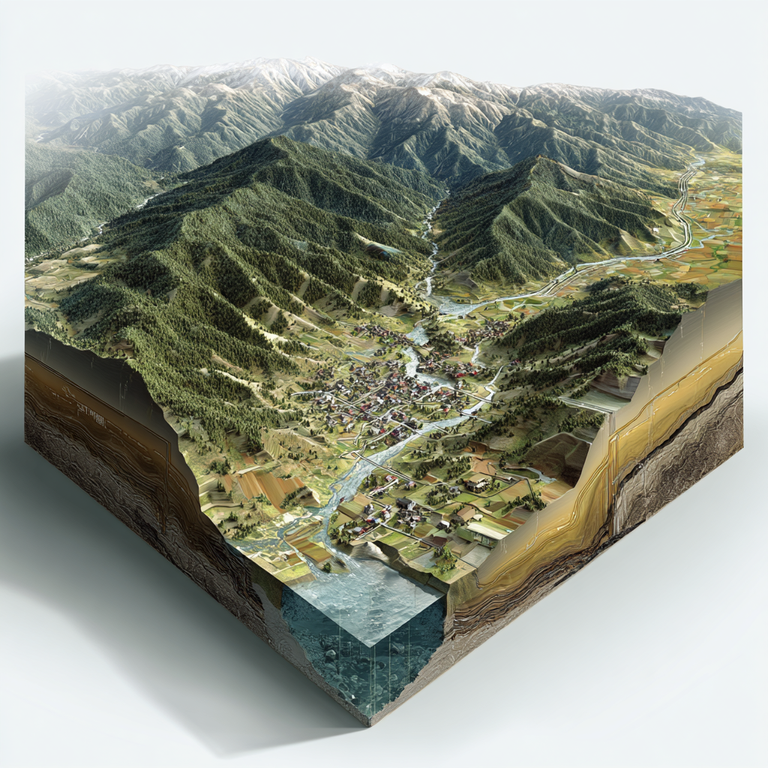
Illustrative basin — surface hydrology, land use, and subsurface context aligned with process-based simulation (e.g. SWAT+) at watershed scale.
Start now
Data backbone (citations & resolutions):
- 25,000+ USGS stations — live context via USGS Water Services (instantaneous values often ~15-minute; see USGS for provisional data caveats)
- NHDPlus HR — built from 1:24,000 NHD, 10 m 3DEP, and WBD; USGS cites on the order of ~27 million flowlines vs ~3 million in NHDPlus V2 (USGS NHDPlus HR)
- PRISM gridded climate (~4 km cells; PRISM defines a “day” as 24h ending 12:00 GMT); NLCD land cover 30 m; gSSURGO soils (gridded SSURGO per NRCS); NSRDB solar/meteorology nominally ~4 km (≈0.038°), 30-minute series — SWATGenX may resample/regrid for operations; see methodology for lineage
Data provenance & methodology — citations, native vs operational resolution notes, and limitations.
Simulation plus screening on one platform
Many tools split “quick maps” and “serious models.” SWATGenX links them: the same national fabric supports flood context and downloadable SWAT+ simulation workspaces.
Screening vs SWAT+ simulation
Screening answers portfolio questions with recent USGS streamflow, return-period classification (Log-Pearson Type III on annual peaks, naming USGS Bulletin 17C as its framework without the standard's low-outlier screening or regional-skew weighting), and PRISM percentile rainfall classes. When you need multi-year process responses or defensible SWAT+ scenarios, download a project package and continue locally.
EPA describes SWAT as simulating water quantity and quality effects of land management and climate; SWAT+ extends that role with a restructured, relational model design.
What you can do with SWATGenX
- Scenario analysis in the SWAT sense: land management, climate series, and multi-year continuous responses
- Screening → simulation ladder: stay in map metrics until you need process-based SWAT+ time series and downloadable projects
- Constituent and sediment questions tie to soils, land cover, and climate inputs already on the platform
- Water-quality angle: dedicated water-quality modeling software page (nutrients, sediment, BMP scenarios)
Model Creation API examples (Jupyter + Python): GitHub.