Automated U.S. watershed modeling
How SWATGenX builds SWAT+ watershed models
This is the SWAT+ model generation methodology behind SWATGenX: how NHDPlus-HR hydrography, national soils, land cover, and climate inputs, and QSWAT+ / SWAT+ Editor assembly turn a selected U.S. basin into a downloadable project package—with quality checks at every step.
Overview
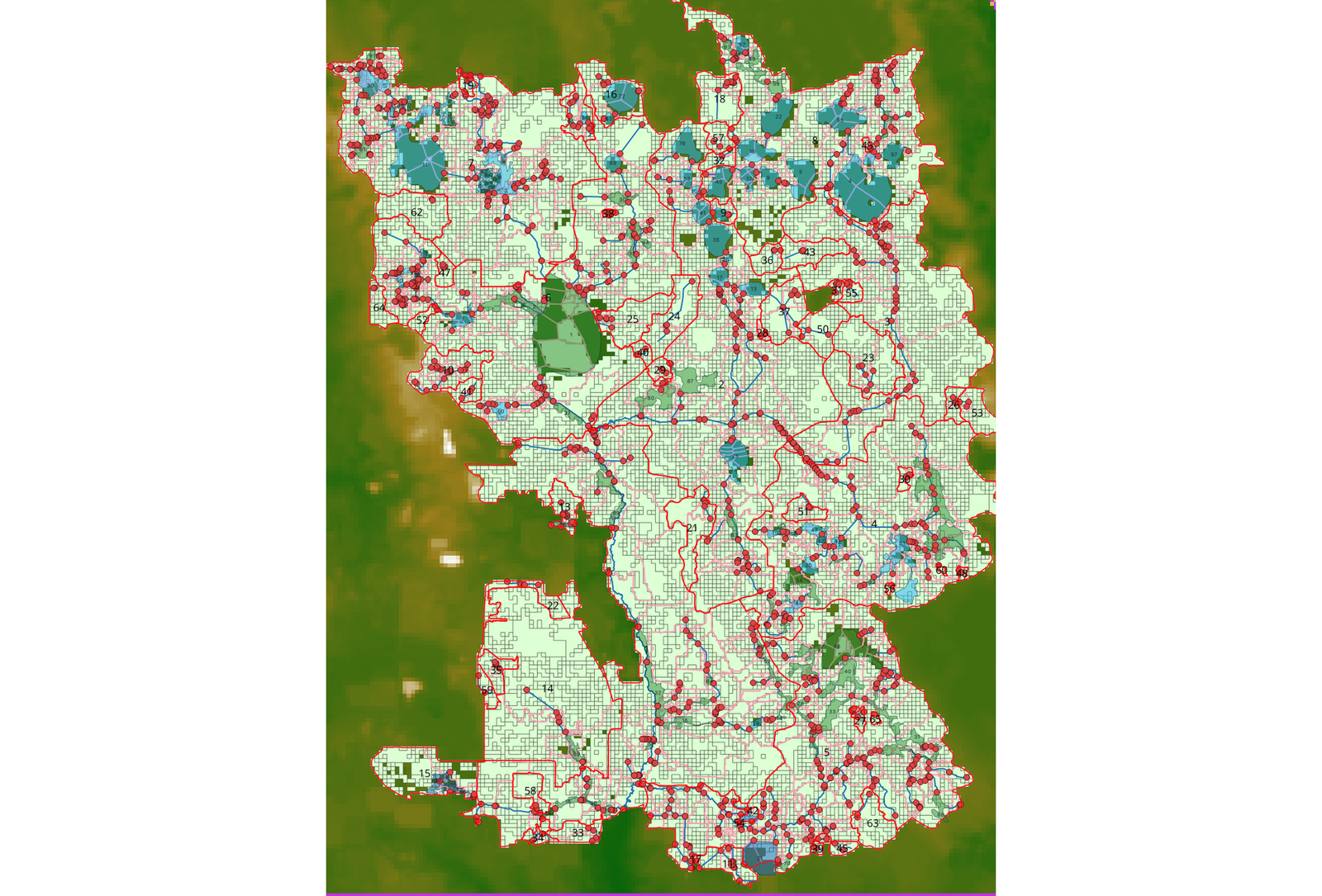
SWATGenX is designed to automate the preparation of SWAT+ (SWAT Plus) watershed model packages for U.S. watersheds. A user-selected USGS gage, HUC12 outlet watershed, HUC8 basin, or hand-picked HUC14 single-catchment set is converted into a model domain, then SWATGenX assembles hydrography, subbasins, channels, HRUs, weather, land cover, soils, crop, and water-use inputs into a downloadable SWAT+ project structure.
This page documents the methodology behind that process. It focuses on model-generation logic, data preprocessing, assumptions, quality checks, and known limitations. Supporting flood-screening reports are described separately because they are secondary outputs, not the core modeling product.
Every check a build runs, and whether it stops the build, is listed in how we check models. How future climate is applied to a SWAT+ model, with 20 downscaled CMIP6 models, is described in climate change and watershed flow. Channel water temperature comes from the engine's heat balance (methods).
Data versions. Each model is built from fixed releases, not live feeds: USGS NHDPlus HR National Release 2 for streams and catchments; the NHDPlus HR elevation raster (derived from 3DEP), used at 30 m; NLCD 2021 land cover; USDA CDL 2015–2019 for crop rotations; gSSURGO soils (the release year is not yet recorded in our build records); and daily PRISM (4 km) and NSRDB (GOES aggregated v4.0.0) weather for 2000–2024. USGS streamflow for calibration is read from NWIS when the model is calibrated. The groundwater well inventory is different: it is a living inventory, refreshed as state agencies publish, and its counts are live.
- National datasets & standards
- Automated prep & QC pipeline
- Reproducible & transparent
- Built for accuracy at scale
Watershed selection and model domain
SWATGenX supports four model-domain entry points:
- USGS gage workflow — the model domain is defined around a streamgage and its contributing watershed.
- HUC12 outlet workflow — the model domain is defined from a selected WBD HUC12 outlet watershed or catalog watershed.
- HUC8 workflow — the model domain is defined as a whole eight-digit hydrologic unit for larger basin-scale model preparation.
- HUC14 single-catchment workflow — drill inside a HUC12 in the Watershed Explorer and hand-pick individual NHDPlus-HR catchments (with recursive upstream selection); the model domain is delineated at fine resolution (30 m) for site-scale studies. This is how the research SWAT+/MODFLOW 6 PFAS site models (e.g. Wurtsmith AFB, Gabreski ANGB) are delineated.
Further technical articles
Deeper, page-length notes on setup pain points and automation tradeoffs (linked from SWAT+ model generation):
Related pages
- SWAT+ model generation — product overview
- How it works — end-user workflow
- Station assignment
- Drainage area audit
- Compare watershed modeling software
- Watershed modeling guide — definitions
- Watershed Explorer — interactive workspace
- Peace River HUC8 (Florida) case study — published SWAT+ walkthrough
- About SWATGenX — mission and who builds it
- Contact — product, API, and partnership inquiries
Common questions
How does SWATGenX use NHDPlus HR in SWAT+ model generation?
The pipeline clips NHDPlus HR Version 2.1 stream networks, catchments, and flowlines to your basin boundary, repairs topology gaps, assigns subbasins and reaches, and exports hydrography layers that QSWAT+ consumes directly. You do not manually delineate watersheds in ArcGIS or run QSWAT+ preprocessing yourself.
What national inputs are assembled before QSWAT+ builds the SWAT+ project?
After hydrography is prepared, the system layers gSSURGO soils, NLCD land cover, 3DEP terrain derivatives, and PRISM or NLDAS weather onto HRUs. USGS streamgages supply calibration context. Optional MODFLOW 6 grids are kriged from state well logs when groundwater coupling is enabled for the order.
What quality assurance checks run during automated SWAT+ model building?
Each order passes drainage-area checks against NHDPlus HR and USGS gages, reach topology validation, HRU coverage thresholds, and station-to-channel assignment QA before the SWAT+ Editor workspace is packaged. Failed checks block download until the basin settings are corrected or a support review resolves the issue.
What SWAT+ toolchain versions does the methodology page document?
Production model builds use QSWAT+ 4.0.3 for geoprocessing, SWAT+ Editor 4.0.1 for project assembly, and a maintained SWAT+ engine fork (not an upstream release number) documented on this page with its git tag. The page explains how those components connect in the NHDPlus HR pipeline end to end.