Triage first. Model what matters.
Screen U.S. watersheds and promote to SWAT+ models
The Watershed Explorer puts 25,000+ USGS stations, HUC8/HUC12 navigation, live streamflow vs flood-frequency classes, rainfall percentiles, and exposure layers on one CONUS map — so you rank a portfolio of basins before spending a single modeling dollar.
Export a PDF watershed report for the short list; promote finalists to SWAT+ builds on the same national data you just screened — no second GIS project to reconcile.
- 25,000+ USGS stations
- Live flow vs LP3 classes
- PDF watershed reports
- One-click promotion to SWAT+
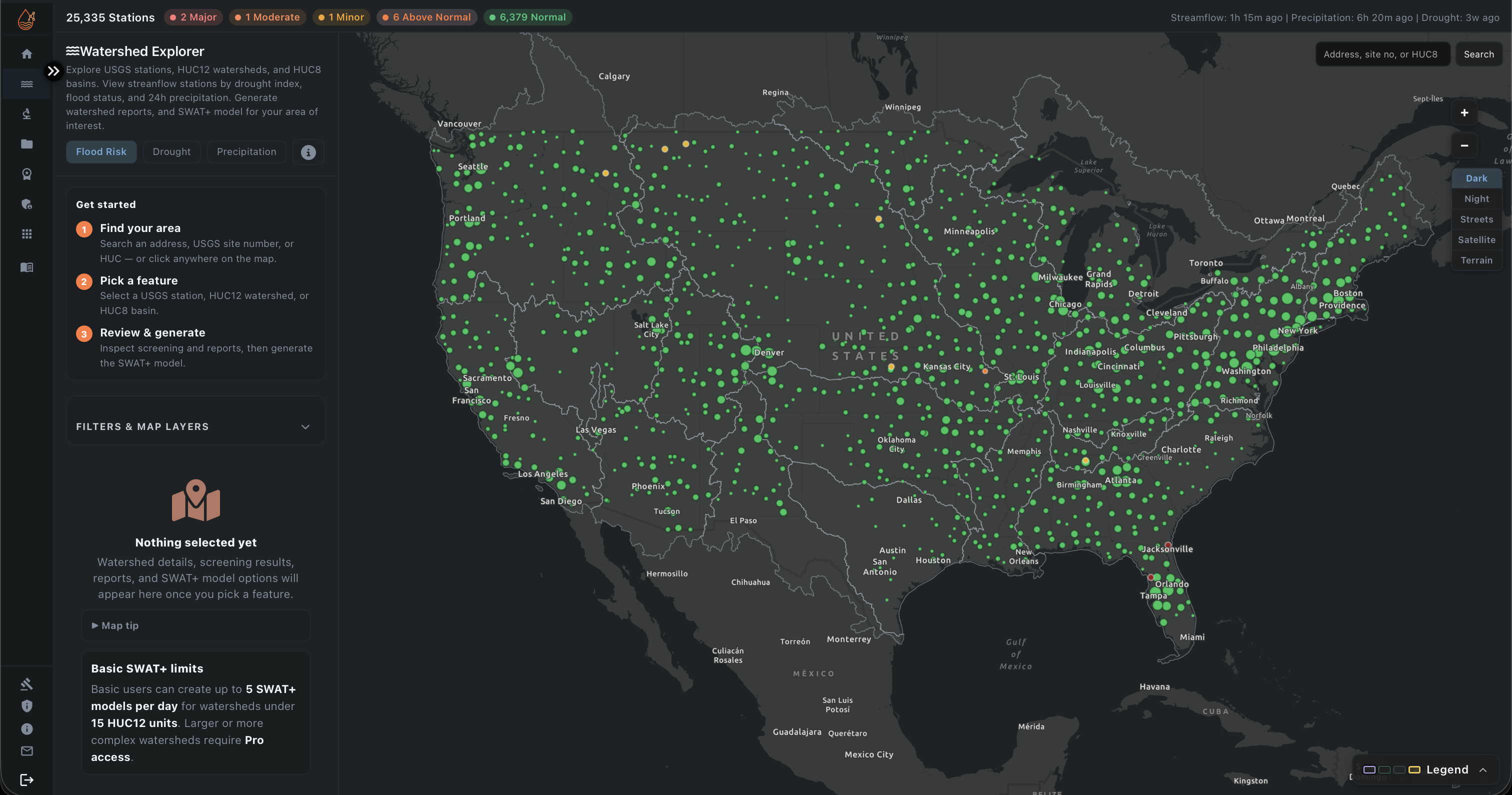
Portfolio triage: start at CONUS, narrow to an HUC8 footprint or catalog outlet HUC12, drop to a USGS gage, and read streamflow class, rainfall class, floodplain-style zones, cropland and stream summaries, and population exposure without rebuilding national layers in desktop GIS.
Export consistent watershed PDFs for a gage, a single catalog HUC12, or an entire HUC8, then order SWAT+ packages that inherit the same hydrography, soils, land cover, and climate lineage — so screening evidence and model inputs stay aligned.
Regional planners, resilience analysts, capital-planning leads, permit screening teams, and grant writers who must rank many basins before detailed study budgets.
Screening cannot answer every capital or regulatory question: it is triage and documentation — not a substitute for NFIP maps, emergency alerting, or hydraulic engineering sign-off where those apply.
How basin triage works in SWATGenX
Start at CONUS scale: filter and color stations, toggle HUC8 and catalog HUC12 layers, and open the side panel for legends, tooltips, and actions.
Narrow to HUC8, HUC12, or gage: compare streamflow and rainfall signals, land cover, and exposure overlays inside one session — WBD identifiers keep basins comparable across your portfolio.
Document and promote: export the PDF watershed report for briefings, then create a SWAT+ model job for the same outlet when leadership approves funding. Preview the report structure from the home page sample before you commit.
Start now
Data backbone (citations & resolutions):
- 25,000+ USGS stations — live context via USGS Water Services (instantaneous values often ~15-minute; see USGS for provisional data caveats)
- NHDPlus HR — built from 1:24,000 NHD, 10 m 3DEP, and WBD; USGS cites on the order of ~27 million flowlines vs ~3 million in NHDPlus V2 (USGS NHDPlus HR)
- PRISM gridded climate (~4 km cells; PRISM defines a “day” as 24h ending 12:00 GMT); NLCD land cover 30 m; gSSURGO soils (gridded SSURGO per NRCS); NSRDB solar/meteorology nominally ~4 km (≈0.038°), 30-minute series — SWATGenX may resample/regrid for operations; see methodology for lineage
Data provenance & methodology — citations, native vs operational resolution notes, and limitations.
How shortlisted basins become SWAT+ jobs
Promotion reuses the same national fabric you just screened — no second GIS project to reconcile layers. Queue the build from the workspace when the basin passes your internal criteria.
Indicators available before full modeling
- CONUS map with 25,000+ USGS stations, HUC8 polygons, and WBD catalog HUC12 outlets
- Live streamflow vs. LP3 quantiles (Q2–Q500) plus MRMS vs. PRISM-percentile rainfall classes
- DEM-derived floodplain-style zones, population exposure, cropland, and stream summaries
- Automated PDF watershed reports and a direct path to SWAT+ orders for finalists
Screening outputs support prioritization, planning, and early review. They are not FEMA flood maps, NFIP determinations, official emergency warnings, or substitutes for project-specific hydraulic studies and designated regulatory sources.
Next steps
Appropriate use
Flood and rainfall indicators on SWATGenX are for rapid triage and planning context, not a substitute for site-specific hydraulic studies, FEMA flood insurance studies, or official emergency warnings. For methodology and citations see Data & methodology. Account rules and data practices are in the Terms of Use and Privacy Policy.