Guide
Watershed modeling, explained
What a watershed model is, how one is actually built step by step, which software fits which question — and the national datasets every US model is cut from. Written by people who build and calibrate these models daily.
- 7 common questions answered
- 7-step build walkthrough
- US data backbone
What is watershed modeling?
Watershed modeling is the use of mathematical equations to simulate how water moves through a drainage basin — rainfall becoming runoff, infiltration, groundwater and streamflow. A watershed model combines terrain, soils, land cover and climate to predict quantities you cannot measure everywhere, such as flow, sediment and nutrient loads.
Watershed modeling is the process of using mathematical representations to simulate how water moves through a drainage basin — from precipitation falling on the land surface, through infiltration, surface runoff, streamflow routing, and eventually to a basin outlet or downstream water body. Watershed models integrate climate, topography, soils, land cover, and human management to predict quantities like streamflow, flood peaks, sediment loads, and nutrient concentrations.
Watershed modeling software packages these mathematical processes into tools that practitioners can apply to real basins. The software reads geospatial and time-series inputs (elevation, hydrography, rainfall, temperature), runs the simulation engine, and produces outputs that inform decisions about flood risk, water supply, water quality, and land management.
Watershed models are used by federal agencies (EPA, USGS, USACE, NOAA), state water authorities, engineering consultants, agricultural planners, and academic researchers. In the United States, the major national watershed modeling programs include SWAT/SWAT+, HEC-HMS, EPA SWMM, and the NOAA National Water Model.
How do you make a watershed model?
You delineate the basin from a digital elevation model, divide it into modeling units, attach soils, land cover and weather to each unit, choose an engine, run it, then calibrate parameters against observed streamflow and validate on a period you did not calibrate on. Automated platforms perform these steps from a gauge identifier.
Below is the sequence in full. It is deliberately tool-agnostic — the steps are the same whether you carry them out by hand in desktop GIS or a platform performs them for you. What changes is how much of it you do yourself.
- Define the outlet and delineate the basin
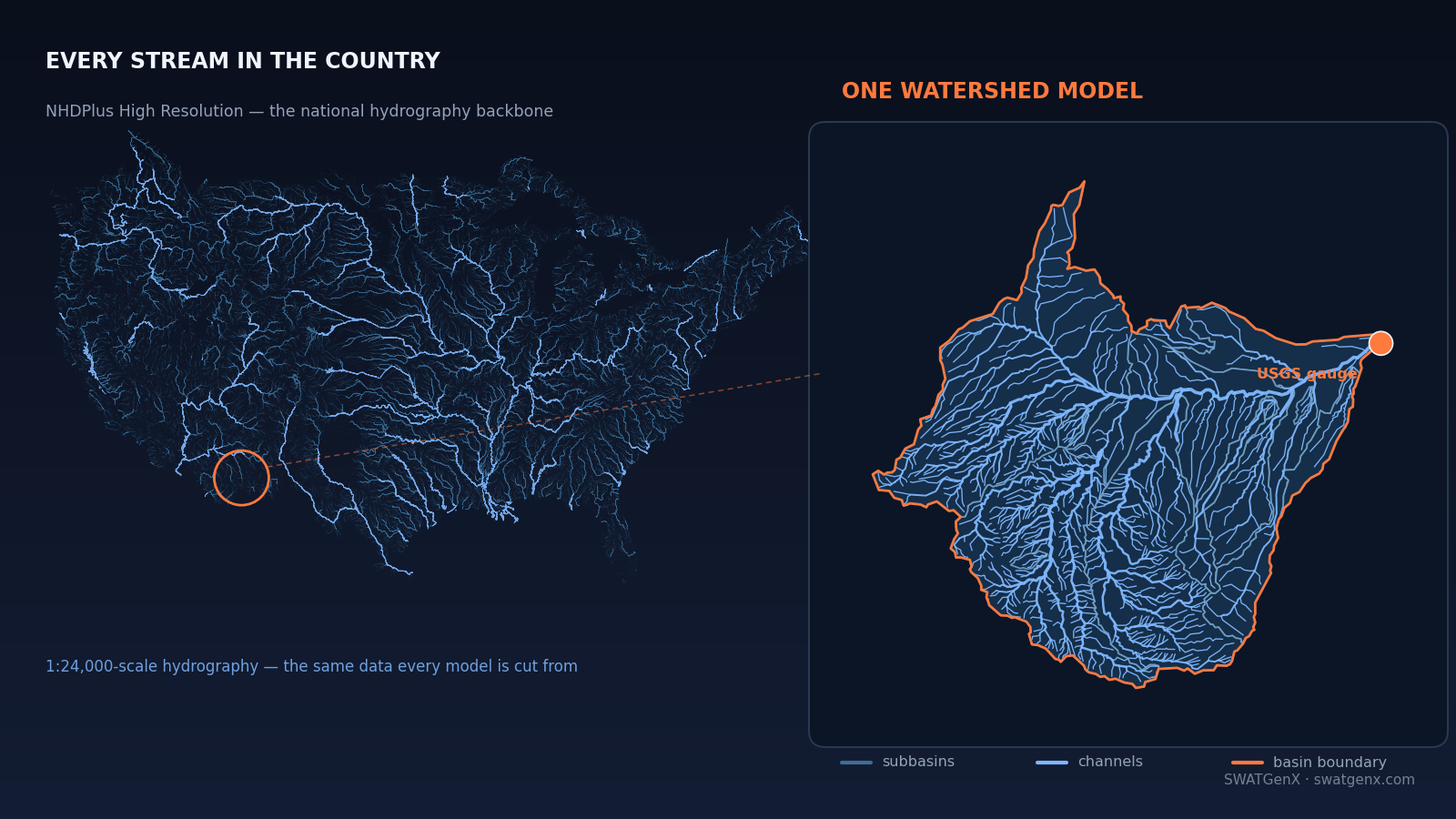
Pick the point you care about — usually a USGS gauge or a reservoir — and use a digital elevation model to trace every cell draining to it. This produces the watershed boundary and the stream network. Delineation is the most fragile step: sinks, flat terrain and road embankments all break flow paths, which is why burning a mapped hydrography such as NHDPlus HR into the DEM is standard practice.
- Divide the basin into modeling units
A model does not solve one equation for the whole basin. It splits it into subbasins along the channel network, then subdivides those into units of similar land cover, soil and slope — in SWAT+ these are hydrologic response units (HRUs). Each unit gets its own water balance, and the channel network routes their output downstream.
- Attach the physical data
Every unit needs soil hydraulic properties (gSSURGO), land cover (NLCD or the Cropland Data Layer), slope from the DEM, and management if the land is farmed. This is where most of the manual effort historically goes: acquiring, reprojecting and clipping national rasters to one basin.
- Attach the weather
The model needs daily precipitation and temperature at minimum, and solar radiation, humidity and wind for physically based evapotranspiration. For CONUS these come from PRISM (4 km) and NREL solar data. Weather is the single largest source of input uncertainty in most basins.
- Run the simulation
The engine steps through time, computing the water balance for every unit and routing flow through the channel network. Include a warm-up period — commonly two years — so soil moisture and groundwater storage reach a realistic state before the results you intend to use.
- Calibrate against observations
Raw model output will not match reality. Adjust the parameters that control runoff generation, groundwater response and routing until simulated streamflow matches a gauge record. Be aware of equifinality: many parameter sets fit equally well, so constrain the search with physical reasoning rather than fitting blindly.
- Validate on a period you did not calibrate on
Split the record. Calibrate on one period, then test the same parameters on a different one. A model that performs well in calibration and poorly in validation has been fitted to noise. This step is what separates a model you can defend from one you cannot.
Done by hand, steps 1 through 4 are where the weeks go — acquiring national rasters, reprojecting them, repairing a delineation that will not close. SWATGenX automates exactly those steps for any US watershed from a gauge number, and hands back a SWAT+ project you can open and refine in your own tools. The judgement in steps 6 and 7 still belongs to you.
Watch SWATGenX in 100 seconds, or read the full lesson curriculum.
Types of watershed models
Watershed models are broadly classified by their representation of physical processes and their spatial/temporal approach:
Empirical (statistical) models
Empirical models use observed relationships between inputs and outputs without explicitly solving physical equations. Examples include regression-based flood frequency analysis and the Rational Method for peak runoff estimation. These are fast and useful for screening but limited in their ability to represent changing conditions.
Conceptual (semi-distributed) models
Conceptual models simplify the watershed into interconnected storage units — for example, soil moisture zones, groundwater reservoirs, and channel segments. They require calibration against observed data. The SWAT (Soil and Water Assessment Tool) family is the most widely used conceptual watershed model worldwide, simulating water balance, sediment, nutrients, and agricultural management across sub-basins connected by a channel network.
Physically-based (distributed) models
Physically-based models solve governing equations (Saint-Venant, Richards' equation, advection-dispersion) on a grid or mesh. Examples include ParFlow (integrated surface–subsurface), MIKE SHE, and elements of the National Water Model (WRF-Hydro/Noah-MP). They require extensive parameterization and computational resources but can represent fine-scale processes like groundwater–surface water interaction.
Event-based vs. continuous models
Event-based models simulate individual storms (e.g. HEC-HMS for design-storm flood hydraulics). Continuous models simulate multi-year periods including dry spells, seasonal cycles, and long-term trends (e.g. SWAT+ with daily or sub-daily time steps). Some platforms support both modes.
Calibration and validation
Calibration adjusts model parameters so simulated outputs (e.g. streamflow) match observations over a chosen period. Validation tests those parameters on an independent period. Together they quantify how credible a model is for the question you are asking — screening platforms may stop short of full calibration; project-grade studies usually require both.
U.S. data backbone (at a glance)
This guide keeps the short definitions here; stewards, resolutions, temporal coverage, and how SWATGenX uses each source are centralized on the methodology & provenance page.
- WBD / HUCs — USGS hydrologic unit codes organize analyses (e.g. HUC8, HUC12).
- NHDPlus HR — high-resolution national hydrography and hydrologic derivatives.
- PRISM — gridded daily precipitation and temperature for CONUS.
- NLCD — USGS MRLC land cover time series.
- gSSURGO — USDA NRCS gridded soils.
- USGS NWIS — streamflow observations and annual peaks for frequency context.
See also use cases and access levels.
Major watershed modeling software for the US
SWAT / SWAT+
The Soil and Water Assessment Tool is one of the most cited watershed models globally. SWAT+ is the restructured successor with object-based code, SQLite-backed tooling (QSWAT+ and SWAT+ Editor), and flexible spatial routing. SWAT+ supports continuous simulation of water balance, nutrients (nitrogen, phosphorus), sediment, crop growth, and management practices. SWATGenX automates SWAT+ model generation for U.S. watersheds at national scale.
HEC-HMS
The Hydrologic Engineering Center's Hydrologic Modeling System is a USACE product for event-based and continuous rainfall-runoff simulation. HEC-HMS is widely used for flood analysis, dam safety studies, and FEMA floodplain mapping. It requires user-supplied geometry and boundary conditions; there is no preloaded national dataset layer.
EPA SWMM
The Storm Water Management Model is designed for urban stormwater and combined sewer systems. SWMM simulates runoff quantity and quality at the pipe/conduit scale. It is the standard for urban drainage design but does not target watershed-scale water-balance or agricultural modeling.
ParFlow
ParFlow is an open-source, physically-based integrated hydrologic model that couples surface and subsurface flow using variably saturated Richards' equation solved on a parallel computational grid. It is used in research for groundwater–surface water interactions at high spatial resolution.
National Water Model (NWM)
NOAA's operational hydrologic forecast system runs WRF-Hydro/Noah-MP coupled land-surface routing on NHDPlus V2. It provides analyzed and forecast streamflow at national scale but is not a user-facing model-building platform — you consume its outputs, not submit your own scenarios.
HAWQS
The Hydrologic and Water Quality System is an EPA-supported web platform for SWAT classic with preloaded national inputs at medium resolution (NHDPlus V2). HAWQS targets standardized water-quality scenario analysis.
How watershed modeling tools compare
The right watershed modeling software depends on your primary use case: event-based flood design, continuous water-balance simulation, urban stormwater, operational forecasting, or automated screening and reporting. Key differentiators include:
- Modeling engine — SWAT+ vs HEC-HMS vs SWMM vs ParFlow vs WRF-Hydro; each targets different processes and scales
- Data backbone — preloaded national datasets (NHDPlus HR, PRISM, gSSURGO) vs user-supplied geometry; this determines time-to-first-result
- Deployment — browser-based platform (SWATGenX, HAWQS) vs desktop application (HEC-HMS, SWMM, ParFlow); affects accessibility and IT overhead
- Spatial resolution — NHDPlus HR (~27M flowlines, 1:24,000) vs NHDPlus V2 (~2.7M segments, 1:100,000) vs user-defined grids
- Automation — fully automated pipeline (SWATGenX) vs manual project setup (most desktop tools)
- Output scope — screening-only, reports-only, or full downloadable model packages for offline work
For the full side-by-side comparison table covering SWATGenX, HAWQS, HEC-HMS/RAS, EPA SWMM, and the National Water Model, see the watershed modeling software comparison.
Data sources for US watershed modeling
Effective watershed modeling requires nationally consistent, well-documented datasets. In the United States, the following public datasets form the foundation:
- NHDPlus HR — high-resolution stream network (~27 million flowlines at 1:24,000 scale) with catchments and routing attributes derived from USGS 3DEP 10 m elevation
- NHDPlus V2 — medium-resolution national hydrography (~2.7 million segments at 1:100,000) used by HAWQS and the National Water Model
- USGS NWIS — real-time and historical streamflow at 25,000+ gaging stations; the primary calibration target for most U.S. hydrologic models
- PRISM — 4 km gridded daily precipitation and temperature (our builds use 2000–2024); the dominant climate input for CONUS watershed modeling
- NSRDB — 2 km solar radiation, humidity, and wind speed from NREL; used by SWAT+ for evapotranspiration calculations
- gSSURGO — 250 m gridded soil properties (USDA NRCS) for hydrologic soil groups, saturated conductivity, and layer depths
- NLCD / USDA CDL — 30 m land cover (NLCD) and crop-specific classification (Cropland Data Layer) for land-use parameterization
- USGS 3DEP — 10 m national elevation dataset via Google Earth Engine for watershed delineation and terrain analysis
SWATGenX pre-integrates all of the above datasets into its pipeline, so users do not need to acquire, reformat, or clip data manually.
Challenges in watershed modeling
Watershed modeling is powerful but involves well-known challenges that affect all platforms:
- Data quality and gaps — rainfall, streamflow, and soils data have spatial and temporal gaps that introduce uncertainty; no model eliminates this
- Calibration and equifinality — multiple parameter sets can reproduce observed streamflow equally well, making it difficult to claim a single "correct" model; good calibration requires observed flow records and domain knowledge
- Scale mismatch — processes that matter at the hillslope scale (infiltration, interflow) may not translate directly to basin-scale model parameters; lumped and semi-distributed models inherently average sub-grid variability
- Computational cost — physically-based models on high-resolution grids (ParFlow, MIKE SHE) require significant compute resources; cloud platforms like SWATGenX absorb this cost for SWAT+ workflows
- Model selection — choosing the wrong tool for the question (e.g. urban-drainage model for a rural watershed, or a steady-state model for flood events) leads to unreliable results regardless of the software
The best approach is to match model complexity to the question being asked, use nationally consistent data where possible, and document assumptions transparently.
Common questions, answered directly
The questions people actually ask about watershed modeling, answered without hedging. Each links into the depth elsewhere on this page.
What does watershed mean in simple terms?
A watershed is all the land that drains to one point — every drop of rain falling inside it eventually passes that outlet. Ridge lines form its boundary. The same area is also called a drainage basin or catchment, and watersheds nest: small ones combine into larger ones.
What is a watershed approach?
A watershed approach manages water by drainage basin rather than by political boundary, because the basin is the unit in which water actually moves. It evaluates upstream and downstream effects together, so an action in a headwater is assessed by its consequence at the outlet.
What is the difference between a watershed model and a hydraulic model?
A watershed (hydrologic) model answers how much water arrives and when, over an entire basin and long periods. A hydraulic model answers how deep and how fast that water flows through a specific channel or floodplain. Flood studies commonly use a hydrologic model to generate flows and a hydraulic model to route them.
How accurate are watershed models?
Accuracy depends on data and calibration, not on the software. A well-calibrated daily streamflow model typically reaches a Nash-Sutcliffe efficiency of 0.5 to 0.8 against gauge records. An uncalibrated model is a hypothesis, not a prediction — always check which one you are being shown.
What software is used for watershed modeling?
The common tools are SWAT+ for continuous water balance and water quality, HEC-HMS for event-based flood hydrology, EPA SWMM for urban stormwater, MODFLOW for groundwater, and ParFlow for integrated surface-subsurface physics. The right choice follows from the question you are asking, not from popularity.
Explore a real aquifer in 3D — live
This is a real SWATGenX model running on this page: a six-layer MODFLOW 6 aquifer beneath a Michigan headwater catchment, built automatically from state well records. Drag to orbit, peel the layers, slice top-down, and hover any cell for its hydraulic conductivity. The scene is the model's MODFLOW_250m configuration, built 2026-06-20.
Where SWATGenX fits
SWATGenX is watershed modeling software that occupies a specific niche: automated, national-scale SWAT+ model generation for U.S. watersheds. It is best suited for:
- Watershed screening — triage basins rapidly using recent USGS streamflow before committing to detailed studies
- Watershed flood screening — gaged streamflow vs. return-period thresholds, rainfall context, and coarse DEM floodplain-style zones (not hydraulic flood risk certification)
- SWAT+ model delivery — receive calibrated, downloadable SWAT+ project packages without desktop GIS setup
- Water quality modeling — simulate nitrogen, phosphorus, and sediment transport at watershed scale
- Reporting — produce automated PDF watershed reports for clients, agencies, and stakeholders
SWATGenX employs QSWAT+ and SWAT+ Editor inside its pipeline. It complements these tools rather than replacing them — users who need custom parameterization can download the SWAT+ project and refine it locally.
To see a watershed model run under future climate, read climate change and watershed flow.
Start now
Data backbone (citations & resolutions):
- 25,000+ USGS stations — live context via USGS Water Services (instantaneous values often ~15-minute; see USGS for provisional data caveats)
- NHDPlus HR — built from 1:24,000 NHD, 10 m 3DEP, and WBD; USGS cites on the order of ~27 million flowlines vs ~3 million in NHDPlus V2 (USGS NHDPlus HR)
- PRISM gridded climate (~4 km cells; PRISM defines a “day” as 24h ending 12:00 GMT); NLCD land cover 30 m; gSSURGO soils (gridded SSURGO per NRCS); NSRDB solar/meteorology nominally ~4 km (≈0.038°), 30-minute series — SWATGenX may resample/regrid for operations; see methodology for lineage
Key concepts
- Engine vs platform: SWAT+ is the modeling engine — the code that solves hydrologic equations. A watershed modeling platform wraps the engine with data, preprocessing, execution, calibration support, and reporting. SWATGenX is that platform layer for CONUS.
- Resolution matters: Hydrography resolution (NHDPlus HR vs V2) determines how many stream segments and catchments the model can represent. Higher detail supports local realism if automation absorbs the extra computational work.
- When you need SWAT+: Use screening and reports for rapid triage; use SWAT+ when you need process-based water balance, land-management scenarios, nutrient routing, or long-term simulation.
- Calibration is essential: A model without calibration against observed streamflow is a hypothesis, not a prediction. SWATGenX automates calibration against USGS records; desktop users calibrate manually in SWAT+ Editor.