
Watershed modeling platform · United States
Build a calibrated watershed model for anywhere in the United States
Pick a USGS streamgage, a HUC12 outlet, or a whole HUC8 basin on the map. SWATGenX assembles the national data, builds a SWAT+ model (with a steady-state MODFLOW 6 groundwater model if you need one), calibrates it against observed flow, and hands you the package — no desktop GIS, no national datasets to maintain yourself.
Open to explore. 25,000+ USGS streamflow stations, with national hydrography, soils, land cover and climate already assembled.
See a model built, end to end
SWATGenX changes where you start. Choose a stream gauge or a watershed anywhere in the lower forty-eight states, and we build a complete, ready-to-run SWAT+ model for it from national data, usually within a couple of hours.
Plays from swatgenx.com, with captions.
Start where the data already is
The Explorer opens on every USGS streamflow station in the conterminous US, coloured by current flood status from the latest instantaneous discharge. Search an address, a site number or a HUC — or click the map. What you select is what gets built: the same hydrography, soils and climate lineage carries into the screening report, the example catalog, and the model package you download.
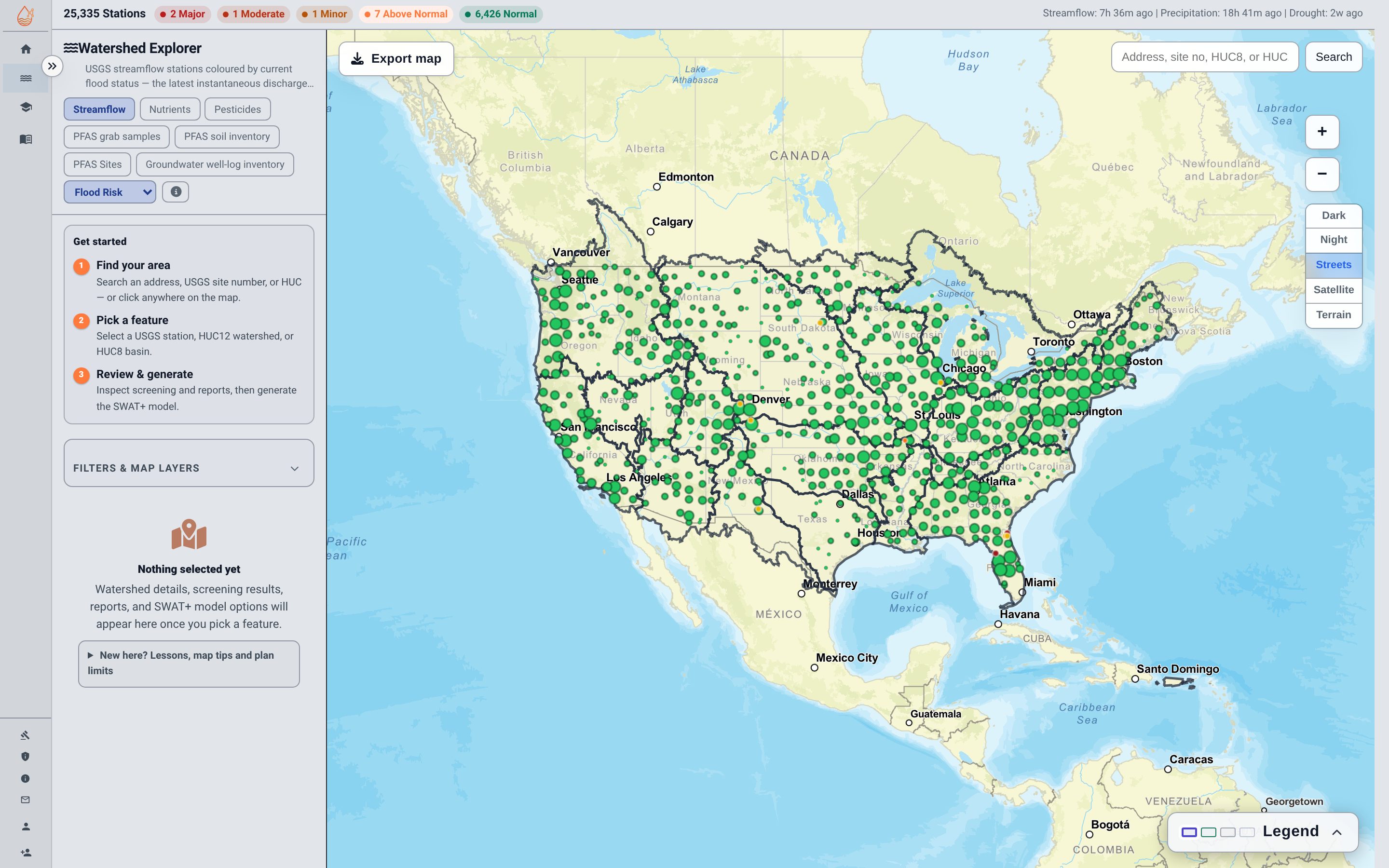
The live Watershed Explorer, captured from production. Station colouring is real-time flood status — this is the actual interface, not a mockup.
One infrastructure, every scale
The same pipeline runs from a whole HUC8 basin down to a 30 m site model. You are not choosing between a national screening tool and a site tool — the coarse model and the nested fine model come from one lineage, so what you find at one scale can be read against the other.
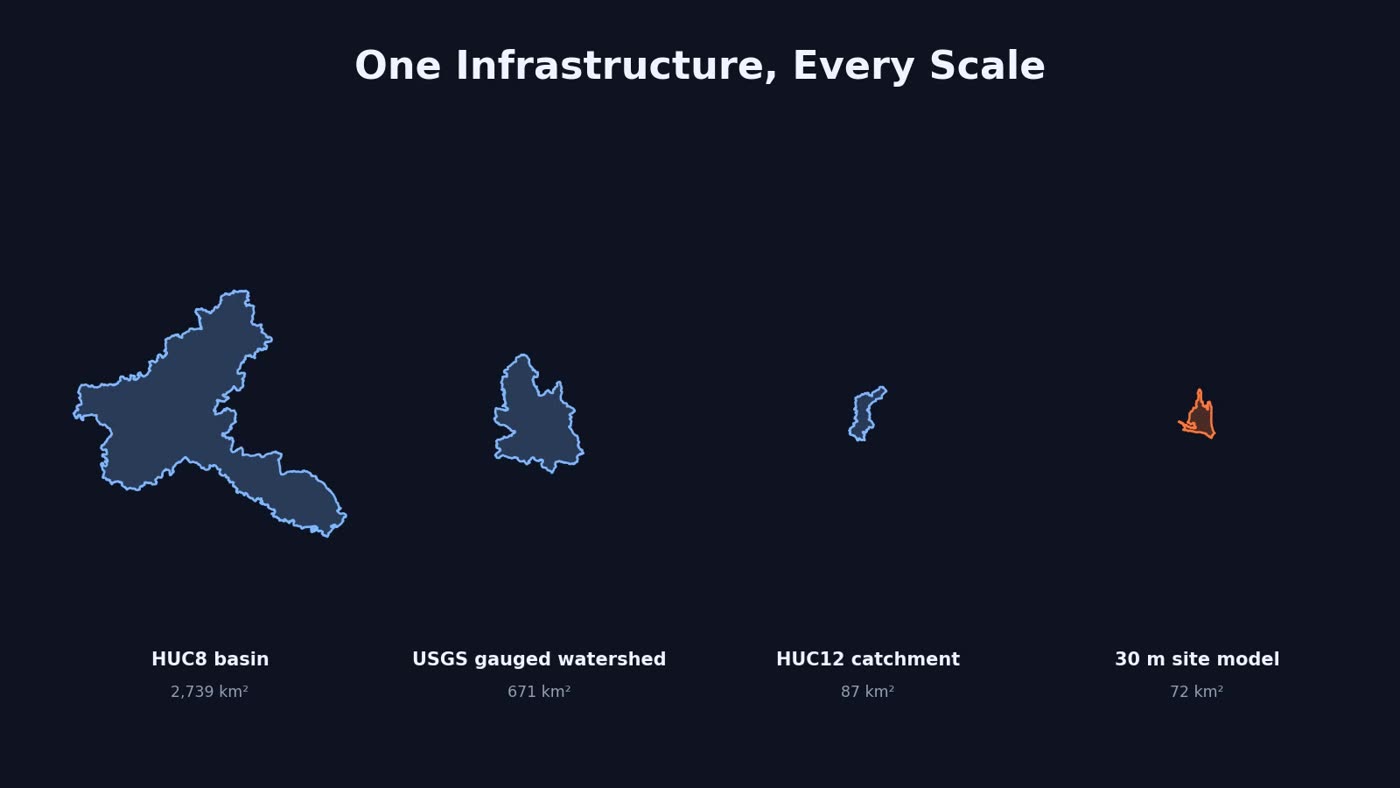
HUC8 basin down to a 30 m site model — one infrastructure at four scales.
What actually goes into the model
Terrain, slope, land use and soils resolve into hydrologic response units; streams, lakes and subbasins come from NHDPlus HR; climate from PRISM and NSRDB. Where the question is a groundwater question, the model couples to MODFLOW 6 rather than approximating the aquifer — the same watershed, one layer deeper.
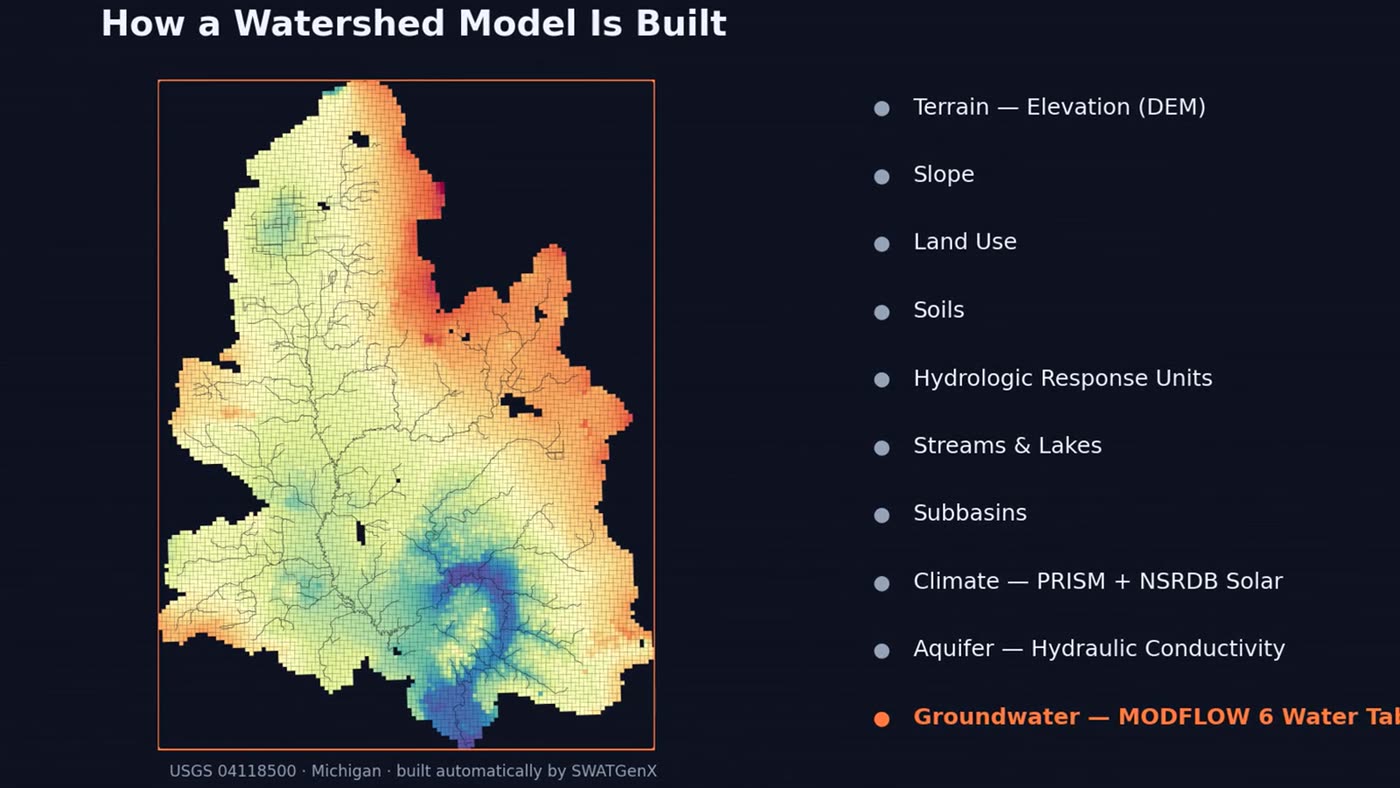
A real watershed decomposed into HRUs, built automatically from national layers.
Calibration you can check
A model that has not been compared with observations is a hypothesis. Calibration runs in the cloud against USGS records and is validated on held-out years, and the comparison ships with the model rather than being summarised for you — the example catalog carries the hydrographs and the scores, including the ones that are merely acceptable.
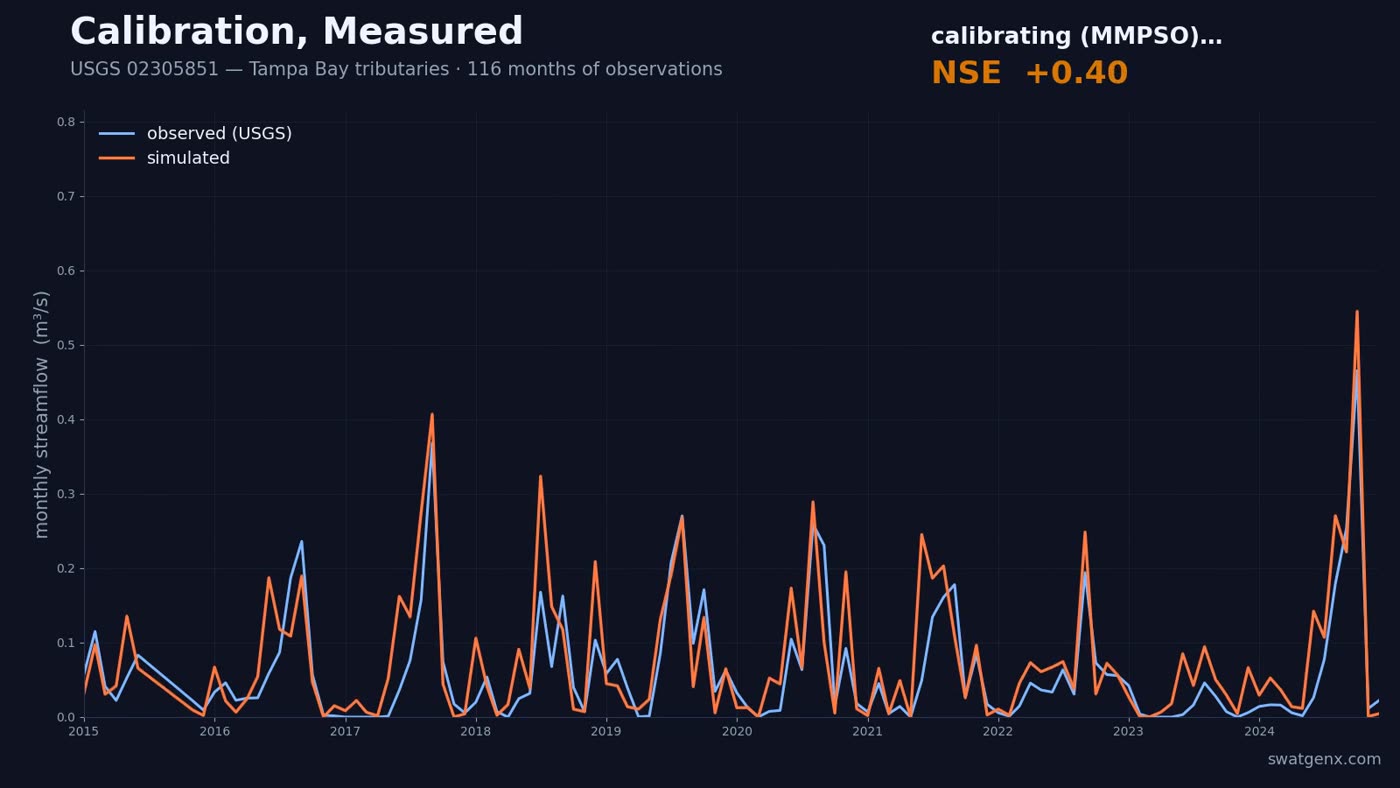
Observed (USGS) against simulated monthly streamflow. Calibration figures ship with the models in the example catalog.
See worked calibration examples · Browse the example model catalog
What this is not
It is not a one-click answer machine. SWATGenX removes the assembly work — the national clips, the format wrangling, the calibration plumbing — so the judgement stays where it belongs: with the person deciding whether a model is fit for the question being asked. Every input layer, parameter set and score is inspectable, and the same REST API behind the interface is there to drive from Python.