Watershed Modeling Software for U.S. SWAT+ Models
Screen any U.S. watershed in your browser, then download a ready-to-run SWAT+ model of it.
SWATGenX is watershed modeling software for U.S. SWAT+ (SWAT Plus). Pick a USGS station, HUC12 outlet, or HUC8 basin and it builds the package for you — terrain, climate, soils, land cover, routing and SWAT+ project files from NHDPlus HR and national datasets. Calibrate in the cloud, with validation on years the optimizer never saw.
What SWATGenX does
Screen watersheds
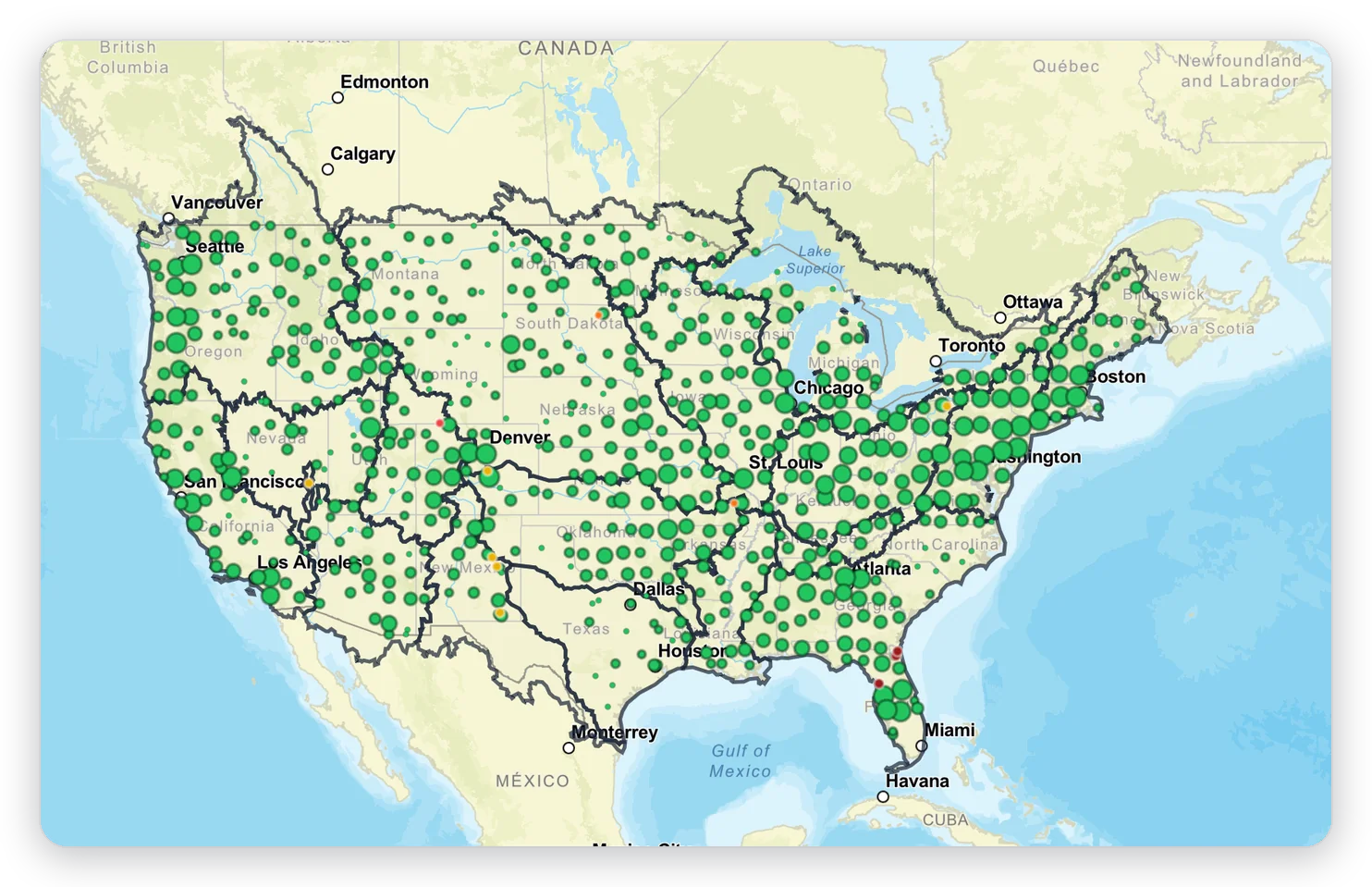
Browse USGS stations, HUC8 and HUC12 boundaries, stream networks, watershed indicators, and live streamflow context in the Watershed Explorer.
Generate SWAT+ models
Create downloadable SWAT+ project packages from NHDPlus HR routing, national climate, soils, land use, and terrain—delivered for QSWAT+ and SWAT+ Editor workflows.
Report and calibrate
Produce PDF watershed briefings and optional cloud calibration and validation outputs when your tier includes them.
SWATGenX is a web-based watershed modeling software platform for the continental United States. It turns national geospatial datasets and NHDPlus HR hydrography into calibrated, validated SWAT+ and SWAT+MODFLOW-6 models — an end-to-end research-and-development environment for engineers and scientists who need trustworthy, reproducible watershed models across many U.S. basins without building the data and calibration pipeline themselves. Map-based screening and PDF reporting are the on-ramp; the deliverable is a defensible model.
Workflow
Select a basin → screen in Explorer → generate a report (optional) → order a SWAT+ package → open in Editor for calibration and scenarios.
Calibration & validation, built in
A model you cannot evaluate is a liability. Every SWAT+ package SWATGenX builds ships with a 10-year diagnostic simulation and an automated SWAT+ Check water-balance review, so you see how the uncalibrated model behaves at every gauge before spending anything on calibration. From there, cloud calibration runs diagnosis-guided optimization against USGS observations on elastic compute — scored on daily and monthly NSE — and then re-runs the calibrated parameters over a held-out validation window of years the optimizer never saw.
This is not a private benchmark: results are published on the public example-model pages. Today 34 of the 81 example models are calibrated and 24 carry held-out validation metrics, with both windows reported side by side — for instance USGS 01451800 (Jordan Creek, PA) at calibration NSE 0.64 and validation NSE 0.75 daily. The count grows as the national calibration campaign works through the catalog.
Two things keep cloud calibration fast and affordable: a diagnosis-guided search that reaches good parameters in far fewer simulations than brute-force optimization, and SWATGenX's accelerated parallel build of the SWAT+ engine — multi-core execution with results identical to the serial engine, so speed never comes at the cost of reproducibility.
How watershed modeling tools compare
SWATGenX is not a replacement for every hydrologic or hydraulic model. It is built for teams that need calibrated, validated SWAT+ and SWAT+MODFLOW-6 models at scale—on national datasets and NHDPlus HR routing, assembled through QSWAT+ and SWAT+ Editor and calibrated in the cloud—without rebuilding the data, delineation, and calibration pipeline for each study area. Selecting a watershed modeling platform for the United States requires understanding three layers that are often conflated: the modeling engine, the geospatial data backbone, and the platform workflow itself.
| Capability | SWATGenX | HAWQS | HEC-HMS / RAS | EPA SWMM | National Water Model |
|---|---|---|---|---|---|
| Engine | |||||
| Modeling engine | SWAT+ | SWAT (classic) | HEC-HMS / HEC-RAS | EPA SWMM | WRF-Hydro / Noah-MP |
| Engine architecture | Object-based, relational DB | Text-file driven | GUI-project based | GUI-project based | Coupled operational NWP |
| Data backbone | |||||
| Hydrography backbone | NHDPlus HR ~27 M flowlines, 1:24 000, 10 m DEM | NHDPlus V2 (pruned) ~2.7 M segments, 1:100 000, 30 m NED | User-supplied | User-supplied | NHDPlus V2 medium-resolution routing |
| National preloaded inputs | |||||
| Web workflow | |||||
| Web-based (no install) | |||||
| Streamflow status screening | 25,000+ USGS stations | forecast mode | |||
| PDF watershed reports | |||||
| Floodplain zone mapping | HEC-RAS | ||||
| Population & cropland analysis | |||||
| Python / AI-agent access | pip · REST · MCP | REST API | data services | ||
| Deliverables | |||||
| Water quality simulation | N, P, sediment | N, P, sediment | runoff quality | ||
| Downloadable model packages | output files | local project | local project | ||
| Calibration & coupling | |||||
| Calibration support | automated + held-out validation | manual | manual | manual | Operational |
| Groundwater coupling | automated SWAT+MODFLOW-6 builds | ||||
| Best use case | |||||
| Primary use case | SWAT+ / SWAT+MODFLOW-6 models, with cloud calibration, as a national R&D platform | Watershed water-quality scenarios | Event-based flood hydraulics | Urban stormwater drainage | National streamflow forecasts |
Next steps
New to the category? Read the Watershed Software Guide. Outcomes: use cases. Limits: access levels. Screening scope: watershed screening tools.
Technical foundation
The hosted pipeline prepares NHDPlus HR channel connectivity, PRISM and NSRDB climate drivers, gSSURGO and NLCD land inputs, and a SWAT+ Editor–aligned project tree—documented end to end in the methodology hub.
Modeling engine: SWAT vs SWAT+
SWAT (the Soil & Water Assessment Tool) is one of the most cited watershed models in the world. It remains actively maintained and widely validated, with command-line executables and text-file input/output.
SWAT+ is a completely restructured redesign of SWAT in which the code organization becomes object-based and the input system becomes relational-based. The core process algorithms remain similar, but SWAT+ was built to address limitations that accumulated over decades of additions and modifications. It is not a patch; it is a major rewrite.
What changes in practice:
- Relational toolchain — SWAT+ Editor stores all model inputs in a SQLite database with foreign-key relationships, so users do not have to manually edit raw text files. The executable still reads ASCII input files at runtime, but the modern toolchain (QSWAT+ + SWAT+ Editor) generates and manages them from the database.
- Flexible spatial connections — SWAT+ allows explicit, user-defined routing between watershed objects (HRUs, landscape units, channels, reservoirs), rather than the fixed subbasin → channel hierarchy of SWAT classic.
- Active extension trajectory — Recent peer-reviewed work demonstrates surface–subsurface coupling via gwflow and SWAT+MODFLOW-6, which matters for any analysis that includes groundwater interaction.
SWATGenX employs SWAT+ (assembled via QSWAT+ and SWAT+ Editor) as its modeling framework, and runs simulations on its open, accelerated build of the SWAT+ engine — multi-core capable with results-identical output (see the parallel engine). HAWQS uses SWAT classic (SWAT 2012 rev. 685 as documented in HAWQS 2.0).
Hydrography backbone: NHDPlus V2 vs NHDPlus HR
The hydrography framework a platform "locks in" determines the size and count of routed stream segments, and therefore the representational detail of channels, catchments, and routing structure. This is often a stronger practical differentiator than the modeling engine alone.
| Attribute | NHDPlus V2 (medium resolution) | NHDPlus HR (high resolution) |
|---|---|---|
| Scale | 1:100,000 (medium-resolution NHD) | 1:24,000 or better (high-resolution NHD) |
| Elevation source | 30 m NED (2012 snapshots) | 10 m USGS 3DEP |
| CONUS flowlines | ~2.7 million segments | ~27 million flowlines (~10× more detail) |
| Best for | National reporting and models where computational cost matters most | Local-to-national analysis requiring fine stream network detail |
| Used by | HAWQS, National Water Model | SWATGenX |
NHDPlus V2 is stable, widely used, and computationally manageable for national-scale reporting. However, it is fundamentally a medium-resolution fabric — many platforms built on it must aggregate or simplify local hydrography features. NHDPlus HR increases the flowline count by roughly an order of magnitude, enabling modeling at local scale while nesting into national context.
The tradeoff is real: hyperresolution modeling is widely viewed as a major scientific goal, but it introduces challenges in data volume, computation, and parameter identifiability. SWATGenX addresses this by automating the preprocessing, calibration, and model-assembly pipeline so that the cost of working with high-resolution hydrography is absorbed by the platform, not by the user.
For the very largest NHDPlus HR basins, teams may still prefer staged calibration passes or more constrained delineation strategies (including TauDEM-oriented alternatives where appropriate) to keep runs operationally manageable.
Below the land surface: groundwater & PFAS
Explore a real aquifer in 3D — live
This is a real SWATGenX model running on this page: a six-layer MODFLOW 6 aquifer beneath a Michigan headwater catchment, built automatically from state well records. Drag to orbit, peel the layers, slice top-down, and hover any cell for its hydraulic conductivity. The scene is the model's MODFLOW_250m configuration, built 2026-06-20.
Most watershed platforms stop at the streambed. SWATGenX builds downward: SWAT+MODFLOW-6 coupled models are constructed automatically alongside the surface model — aquifer geometry and hydraulic properties derived from raw lithology well logs at build time, with head calibration run as part of the pipeline rather than left as an exercise for the user.
The data under those models is a capability in its own right. The national groundwater inventory — 28.8 million lithology intervals from 7.9 million wells across 46 states — is harvested exclusively from state agency records, with no synthetic gap-filling: what you query is what an agency logged. That standard is what makes the derived aquifer models testable; in state-scale pilots, models parameterized from the inventory predict held-out well heads (wells never used in conditioning) with typical errors of 6–8 m across glacial and bedrock settings.
On top of the coupled framework sits PFAS fate-and-transport modeling — an active research frontier SWATGenX publishes openly: MODFLOW 6 solute transport driven by SWAT+ recharge, demonstrated at contaminated-site scale, with per-soil PFAS initialization drawn from a national soil PFAS inventory and observations from the 98,529+-record monitoring inventory.
HAWQS vs SWATGenX — the two national watershed platforms
Both HAWQS and SWATGenX are web-based platforms with preloaded national inputs for U.S. watershed modeling. The differences lie in the modeling engine, hydrography backbone, workflow scope, and deliverables.
| Dimension | SWATGenX | HAWQS 2.0 |
|---|---|---|
| Engine | SWAT+ (object-based, relational DB tooling) | SWAT classic (SWAT 2012 rev. 685, text-file driven) |
| Hydrography | NHDPlus HR — ~27 M flowlines, 1:24 000, 10 m 3DEP | NHDPlus V2 (pruned) — ~2.7 M segments, 1:100 000, 30 m NED |
| Soils | gSSURGO (250 m gridded) | SSURGO (2018) + STATSGO2 |
| Climate | PRISM (4 km) + NSRDB (GOES v4.0.0), 2000–2024 | PRISM 1981–2020 + NEXRAD 2005–2020 |
| Land use | NLCD 2021 land cover; USDA CDL 2015–2019 for crop rotations (CDL also for floodplain analysis) | NLCD 2016 + CDL 2014–2017 |
| Spatial scales | HUC8, HUC12, USGS station-centered, HUC14 catchment composition (30 m site models) | HUC8, HUC10, HUC12, HUC14 |
| Streamflow status screening | Real-time for 25,000+ stations | |
| PDF watershed reports | Streamflow status, floodplain, population, cropland, stream, water use | |
| Downloadable model packages | Complete SWAT+ project (SQLite + files) | Output files / tables |
| Calibration | Automated cloud calibration, validated on held-out years (metrics published) | Manual parameter adjustment in browser |
| Groundwater coupling | automated SWAT+MODFLOW-6 model construction | |
| Programmatic access | pip install swatgenx · REST API · MCP server for AI agents | REST API |
HAWQS is an EPA-supported platform that excels at standardized national water-quality scenario analysis using the mature SWAT engine. Its documented strengths — preloaded inputs, consistent baselines, and browser-based execution — make it valuable for policy-scale evaluation.
SWATGenX is designed for a different (and complementary) workflow: rapid watershed screening, automated reporting, and SWAT+ model delivery. It pairs the restructured SWAT+ engine with NHDPlus HR high-resolution hydrography and an end-to-end automation pipeline — from data preprocessing through calibration to downloadable model packages — so that working with 10× the stream network detail does not translate into 10× the manual effort.
Compare SWATGenX with other watershed modeling tools
SWATGenX is watershed modeling software, not a comparison directory—but choosing the right tool matters. The sections below compare SWAT+ (as delivered by SWATGenX on NHDPlus HR) with the watershed and hydrology tools teams most often evaluate alongside it.
SWAT+ vs HEC-HMS
HEC-HMS (with HEC-RAS) is the U.S. Army Corps of Engineers standard for event-based flood hydraulics, dam safety, and FEMA floodplain studies. It is a desktop application that models a single storm or design event from user-supplied geometry, hydrology, and boundary conditions. SWAT+ is a continuous, process-based watershed model: it simulates the long-term water balance—runoff, soil moisture, groundwater, sediment, and nutrients—over years to decades. Use HEC-HMS/RAS when you need peak-flow hydraulics at a structure; use SWAT+ (via SWATGenX) when you need continuous basin hydrology and water quality on national NHDPlus HR hydrography without building the GIS stack by hand.
SWAT+ vs ParFlow
ParFlow is a physically based, variably saturated, three-dimensional integrated surface–subsurface flow model built for high-performance computing and research-grade groundwater studies. It resolves the full Richards-equation subsurface and is typically run by specialists on HPC clusters. SWAT+ is a semi-distributed watershed model that is far cheaper to set up and run at regional-to-national scale, with groundwater interaction available through the gwflow and SWAT+MODFLOW-6 coupling pathway. Choose ParFlow for detailed 3D subsurface physics on a focused domain; choose SWAT+ (via SWATGenX) for repeatable, automated watershed modeling across many U.S. basins with downloadable model packages.
SWAT+ vs EPA SWMM
EPA's Storm Water Management Model is explicitly positioned for urban runoff quantity and quality modeling in stormwater and combined sewer/drainage systems. It supports both single-event and long-term simulation. SWMM is the right tool for pipe-level urban drainage design — not for watershed-scale water-balance or water-quality scenario analysis.
SWAT+ vs National Water Model
NOAA's National Water Model provides operational analyzed and forecast streamflow at national scale using the WRF-Hydro / Noah-MP coupled land-surface / routing framework on NHDPlus V2 (medium resolution). It is an operational forecasting system, not a user-facing model-building platform — you consume its outputs, but you do not submit your own scenarios.
Model-building environments (WMS, QSWAT+)
Multi-engine GUI suites like Aquaveo WMS and standalone tools like QSWAT+ focus on building and editing projects across engines. They provide powerful local control but require GIS expertise, manual data assembly, and a local compute environment. SWATGenX automates this layer — it employs QSWAT+ and SWAT+ Editor inside its pipeline, so users receive finished model packages without installing or operating those tools directly.
If you need X, start with Y
- Event hydraulics, dam safety, FEMA studies — HEC-HMS / HEC-RAS (desktop, user-supplied geometry).
- Long-term land management, nutrients, sediment — SWAT/SWAT+ (SWATGenX delivers SWAT+ on NHDPlus HR).
- Operational CONUS forecasts — NOAA National Water Model (consume outputs; different authoring model).
- Detailed 3D surface–subsurface physics — ParFlow (HPC, research-grade; SWAT+ offers gwflow / SWAT+MODFLOW-6 coupling).
- Urban drainage networks — EPA SWMM.
- SWAT+ / SWAT+MODFLOW-6 models with cloud calibration for research & analysis — SWATGenX.
What SWATGenX pushes forward
SWATGenX is not an alternative to QSWAT+ or SWAT+ Editor — it automates and scales them. The platform contribution is in four areas:
- High-resolution hydrography at national scale — SWATGenX ingests NHDPlus HR (~27 million flowlines) and builds SWAT+ projects on top of it. The platform absorbs the computational and data-management cost so that working with 10× the stream network detail is seamless.
- End-to-end automation — From watershed delineation and soil/climate extraction through QSWAT+ setup, SWAT+ Editor parameter initialization, calibration, and output packaging, the pipeline runs without manual intervention. Users select a USGS station, a catalog HUC12 watershed, or an HUC8 basin on a map and receive a finished model.
- Watershed Explorer as the operational surface — Before a model build, teams use the same map to read recent USGS streamflow, rainfall percentiles where configured, watershed-scale exposure rollups, and auto-generated PDF briefings.
- Elastic cloud compute — Model builds run on scalable infrastructure. Users do not need local workstations, GIS licenses, or data-preparation pipelines.
- Agent-native access — The same catalog, data, and model-ordering surface is exposed three ways: the web application, the
swatgenxPython package on PyPI, and a public MCP server that lets AI assistants query data and order models directly — all governed by the same server-side quotas.
National data inputs
All SWATGenX analyses draw from publicly available, nationally consistent datasets — no proprietary data is required. Documented vintages and sources ensure reproducibility.
- NHDPlus HR — high-resolution stream network, catchments, and routing (1:24,000+, 10 m 3DEP)
- USGS NWIS — real-time and historical streamflow for 25,000+ stations
- PRISM — gridded daily precipitation and temperature (4 km; our builds use 2000–2024)
- NSRDB — solar radiation, humidity, wind (2 km)
- gSSURGO — gridded soil properties (250 m)
- NLCD / USDA CDL — land cover and crop classification
- USGS 3DEP — elevation, used through the NHDPlus HR elevation raster at 30 m
One platform, three doors: web, Python, AI agents
Everything on this page is reachable without a browser. The example-model catalog with its calibration metrics, the national groundwater inventory (28.8 million lithology intervals across 7.9 million wells in 46 states), and the PFAS monitoring inventory(98,529+ sampling records) are open to guests — no account — from Python or any AI assistant.
Web application
The Watershed Explorer, model dossiers, calibration wizard, and downloads — the full visual workflow described above.
Python
pip install swatgenx

import swatgenx as sg
sg.catalog(state="FL",
           calibrated_only=True)
Query data as a guest; order and download models with an API key.
AI agents (MCP)
A public MCP server at swatgenx.com/mcp gives Claude, ChatGPT, and other AI assistants ten tools to search models, read calibration results, query groundwater and PFAS data, and order builds — with the access ladder explained in every response.
Data backbone (citations & resolutions):
- 25,000+ USGS stations — live context via USGS Water Services (instantaneous values often ~15-minute; see USGS for provisional data caveats)
- NHDPlus HR — built from 1:24,000 NHD, 10 m 3DEP, and WBD; USGS cites on the order of ~27 million flowlines vs ~3 million in NHDPlus V2 (USGS NHDPlus HR)
- PRISM gridded climate (~4 km cells; PRISM defines a “day” as 24h ending 12:00 GMT); NLCD land cover 30 m; gSSURGO soils (gridded SSURGO per NRCS); NSRDB solar/meteorology nominally ~4 km (≈0.038°), 30-minute series — SWATGenX may resample/regrid for operations; see methodology for lineage
Appropriate use
Flood screening uses USGS annual peaks and a Log-Pearson Type III fit aligned with USGS Bulletin 17C guidance. Short gage records, regulation, land-use change, and non-stationarity increase uncertainty — treat classes as triage, not design certification.
Rainfall context compares recent 24h totals to PRISM-derived historical daily percentiles at the station’s grid cell — not the same as NOAA Atlas design storms or MRMS-based hydrologic design. See Data & methodology for baseline years and caveats.
- Not for regulatory floodplain mapping without a licensed engineering study
- Not a replacement for official watches, warnings, or evacuation orders
- Event-focused engineering hydrology (e.g. USACE HEC-HMS) remains the standard for many design contexts.
Use of the platform is subject to the Terms of Use and Privacy Policy.
Get started
Open the Watershed Explorer, pick a USGS station, catalog HUC12, or HUC8, and move from map context to automated briefings or a SWAT+ model order. Most builds finish within about an hour once they start; some take several hours. The same national stack runs end to end.
Model Creation API examples (Jupyter + Python): GitHub.