Why automate your SWAT+ workflow?
Same engine — different amount of your calendar spent on GIS glue code.
SWAT+ by hand vs ordering
Manual SWAT+ (SWAT Plus) is a research-grade toolchain: powerful, transparent, and unforgiving. Automation does not change the governing equations; it changes who holds the bag for CRS alignment, divergence merges, outlet repair, climate file generation, and the simulation.out sanity check. The sections below contrast the two approaches with behaviors SWATGenX implements in production code.
Manual workflow (typical desktop sequence)
- Acquire DEM, land cover, soils, and hydrography; reproject to a common CRS.
- Clip NHDPlus HR streams/catchments; repair topology and outlet logic by hand.
- Run QSWAT+ for delineation and HRUs; inspect Watershed/Shapes for completeness.
- Populate SWAT+ Editor; wire weather stations and land management.
- Run SWAT+; inspect simulation.out; iterate until stable.
- Package TxtInOut + SQLite for collaborators or HPC.
SWATGenX automated pipeline (same milestones, fewer dead ends)
The product landing copy describes the pipeline as national acquisition and clip → delineation scaffolding → QSWAT+ and SWAT+ Editor steps → packaged folder. Each stage emits machine-checkable artifacts (required shapefiles, weather-sta.cli completeness, simulation.out success line) so regressions are caught before download.
NHDPlus HR’s scale (more than 30 million features, mapped mostly at 1:24,000 or finer, versus about 2.6 million in NHDPlus Version 2 at 1:100,000, by the USGS NHDPlus HR User’s Guide, OFR 2019-1096) is exactly why CONUS automation matters: the cleaning rules must be deterministic and repeatable, not a one-off ArcPy notebook.
National inputs, automated processing, auditable handoffs
Consultants and agencies rarely build one basin — they triage dozens of HUC8s. Manual prep does not scale linearly; context switching between ArcGIS, QSWAT+, and Editor dominates, and each hop is a chance for CRS, topology, or file-list drift.
The SWATGenX diagram is the clearest picture of what “automation” means here: not skipping hydrology, but concentrating watershed preparation in one hosted path from national datasets through automated processing to intelligence outputs, PDF reports, and packaged SWAT+ models — so preparation and completion checks stay aligned with the same build logic your download was produced with.
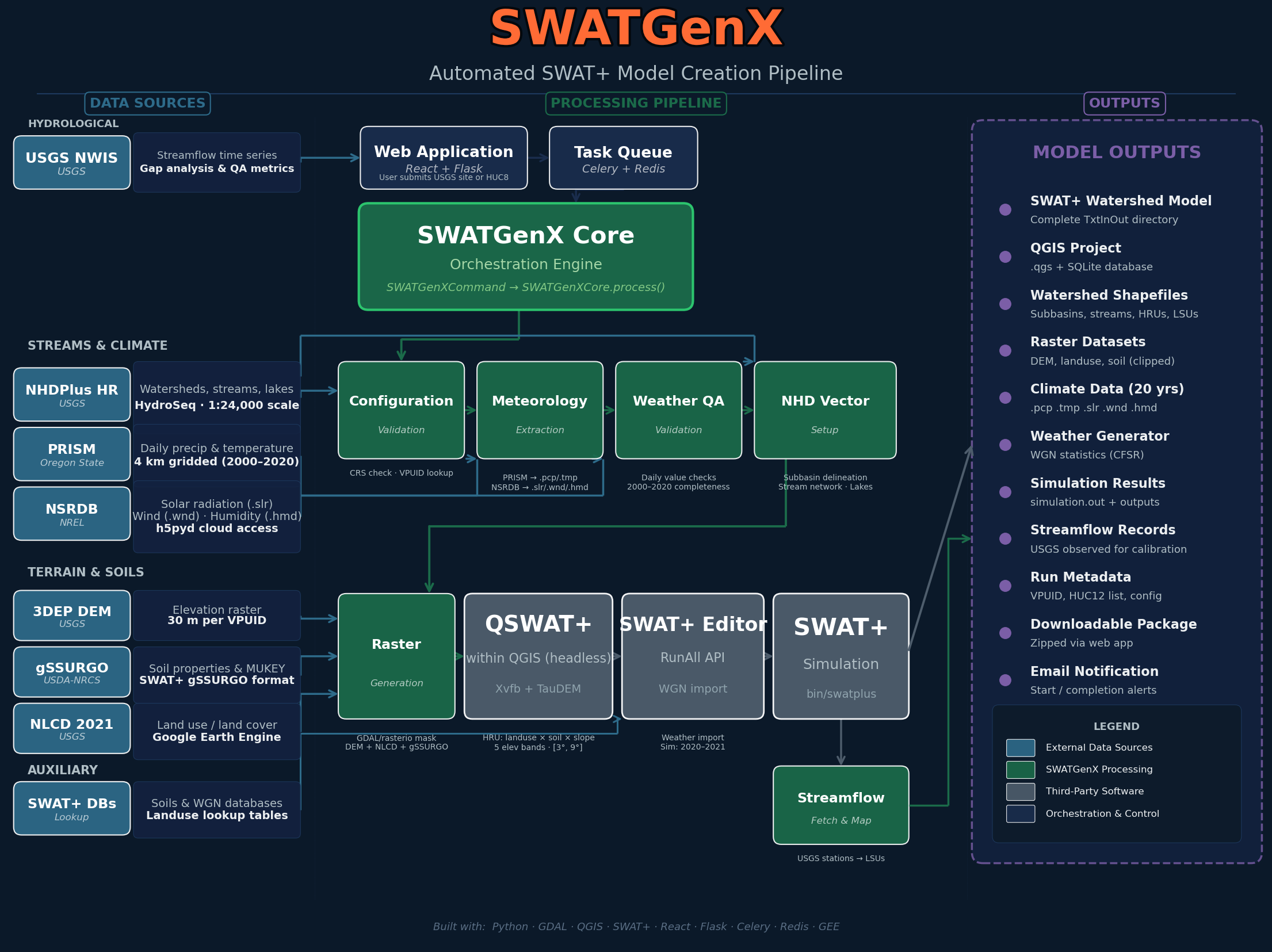
Same figure as platform overview: datasets → processing → outputs. Use it as the mental model for why automated watershed preparation catches errors earlier than a long manual toolchain.
Groundwater and broader workflows
Automation today centers on SWAT+ land-surface hydrology packaging. SWATGenX continues to expand decision-support (for example MODFLOW-oriented workflows in supported regions) — see platform overview and methodology for current scope and limits.
Related guides
These pages are written for people hitting friction in desktop SWAT+ / QSWAT+ workflows — linked from methodology and SWAT+ model generation so they are crawlable, not orphaned.
Try SWATGenX
Next steps
Last updated: 2026-04-16. For dataset stewardship and preprocessing detail, see methodology.