Basin-scale hydrology, continuous in time
SWAT+ hydrologic modeling software for U.S. watersheds
Continuous precipitation–runoff, evapotranspiration, soil moisture, and channel routing in the SWAT+ frame — built for any U.S. watershed from national data, calibrated against USGS observations, and downloadable as an editable model.
Hydrologic, not hydraulic: watershed response over years and decades — not water-surface profiles at structures. That distinction is the first thing this page settles.
- Continuous simulation
- SWAT+ channel routing
- Calibrated vs USGS flow
- Gauge · HUC12 · HUC8 · 30 m site
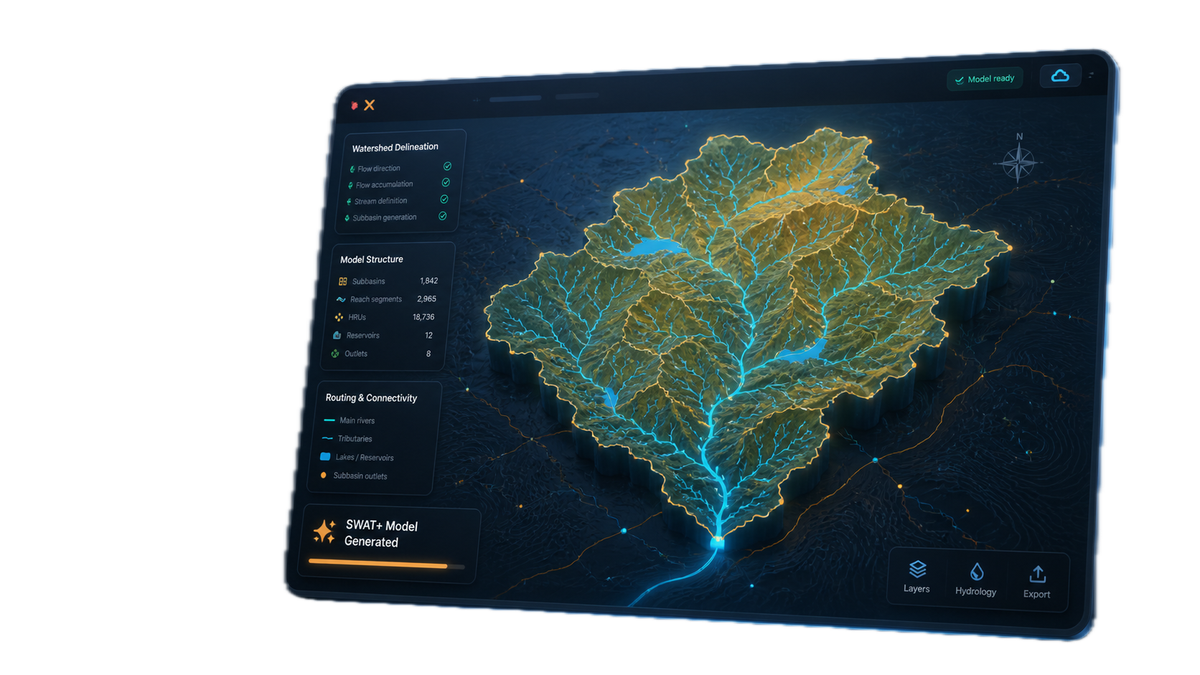
SWAT+ in SWATGenX is hydrologic modeling software in the watershed-simulation sense: precipitation, temperature, soils, land cover, and routing reproduce runoff, soil moisture, and stream response over time — not water-surface elevations at bridges or levees. SWATGenX builds that model for you from national data and hands you the editable project.
You screen or order basins at USGS gages, WBD outlet HUC12 catalog watersheds, whole HUC8 footprints where enabled, or fine-resolution 30 m HUC14 single-catchment site models (drill into a HUC12 and select catchments, with recursive upstream selection). National PRISM and NSRDB-derived weather, NLCD land cover, gSSURGO soils, and NHDPlus HR hydrography are clipped and wired into QSWAT+ / SWAT+ Editor assembly so you receive SQLite-backed SWAT+ projects without rebuilding the GIS stack by hand.
Hydrologists, water-resources engineers, stormwater consultants, and graduate researchers comparing SWAT+, HEC-HMS, and other basin-scale continuous tools.
Hydraulic floodplain certification, FEMA Flood Insurance Rate Map replacement, and structure-focused HEC-RAS studies sit in a different tool class with different data and sign-off requirements.
Hydrologic modeling versus hydraulic modeling
Hydrologic models estimate rainfall–runoff, losses, groundwater context, and channel routing at watershed scale (continuous or daily time steps). Hydraulic models emphasize stage–discharge relationships, structures, and inundation extents for project design.
SWATGenX stays in the hydrologic column: screening maps, PDF watershed reports, and SWAT+ ZIP exports built from the same national lineage. When you need hydraulic certification or regulatory maps, plan on a hydraulic model and designated regulatory sources — not this screen alone.
Explore a real aquifer in 3D — live
This is a real SWATGenX model running on this page: a six-layer MODFLOW 6 aquifer beneath a Michigan headwater catchment, built automatically from state well records. Drag to orbit, peel the layers, slice top-down, and hover any cell for its hydraulic conductivity. The scene is the model's MODFLOW_250m configuration, built 2026-06-20.
Start now
Data backbone (citations & resolutions):
- 25,000+ USGS stations — live context via USGS Water Services (instantaneous values often ~15-minute; see USGS for provisional data caveats)
- NHDPlus HR — built from 1:24,000 NHD, 10 m 3DEP, and WBD; USGS cites on the order of ~27 million flowlines vs ~3 million in NHDPlus V2 (USGS NHDPlus HR)
- PRISM gridded climate (~4 km cells; PRISM defines a “day” as 24h ending 12:00 GMT); NLCD land cover 30 m; gSSURGO soils (gridded SSURGO per NRCS); NSRDB solar/meteorology nominally ~4 km (≈0.038°), 30-minute series — SWATGenX may resample/regrid for operations; see methodology for lineage
Data provenance & methodology — citations, native vs operational resolution notes, and limitations.
Continuous watershed-scale setup
After download you run SWAT+ locally or in your HPC environment, edit scenarios in SWAT+ Editor, and calibrate to your study period. SWATGenX removes the national data assembly step; it does not replace study design, calibration, or peer review.
What a hydrologic workflow looks like here
- Rainfall–runoff, ET, soil moisture, and channel routing in a continuous, watershed-scale SWAT+ frame — not cross-section hydraulic design
- Basin entry the same way you order models: USGS gage, WBD outlet HUC12 catalog watershed, whole HUC8 where enabled, or a fine-resolution 30 m HUC14 single-catchment site model (drill into a HUC12 and hand-pick catchments)
- Inspect lineage before you commit budget: public example models list HRU counts, delineation source (NHDPlus HR or TauDEM), and downloads
- Deeper framing: watershed modeling guide; tool comparison hub: /watershed-modeling-software
SWATGenX focuses on basin-scale hydrologic analysis and SWAT+ package preparation. It is not a replacement for project-specific hydraulic models used for water-surface profiles, structure design, or official inundation mapping. Unless a download is explicitly documented as calibrated for your study objective, treat it as an automated SWAT+ setup for review, editing, calibration, and validation.
Model Creation API examples (Jupyter + Python): GitHub.