01 · National groundwater inventory
The national well inventory — collected and harmonized.
State agency well logs, interval-by-interval — searchable, mappable, and ready for MODFLOW 6 setup.
Explore groundwater data → SWATGenX
SWAT+ models for any river in the lower 48 states, with MODFLOW 6 groundwater models and cloud calibration against USGS streamflow and groundwater heads. Built for consultancies, utilities, and agencies.
Every model is built from the public data and standard engines a reviewer will ask about:
SWATGenX changes where you start. Choose a stream gauge or a watershed anywhere in the lower forty-eight states, and we build a complete, ready-to-run SWAT+ model for it from national data, usually within a couple of hours.
Capability tour
All eight ship in one watershed workflow and one portable SWAT+ project.
01 · National groundwater inventory
State agency well logs, interval-by-interval — searchable, mappable, and ready for MODFLOW 6 setup.
Explore groundwater data →02 · National PFAS data moat
Water, groundwater, soil, and tissue measurements from public agency records — joined with depth-resolved soil reports, potential-source screening, and PFAS litigation dockets for site context.
See the full PFAS data holding →03 · HUC8 → HUC12 → HUC14
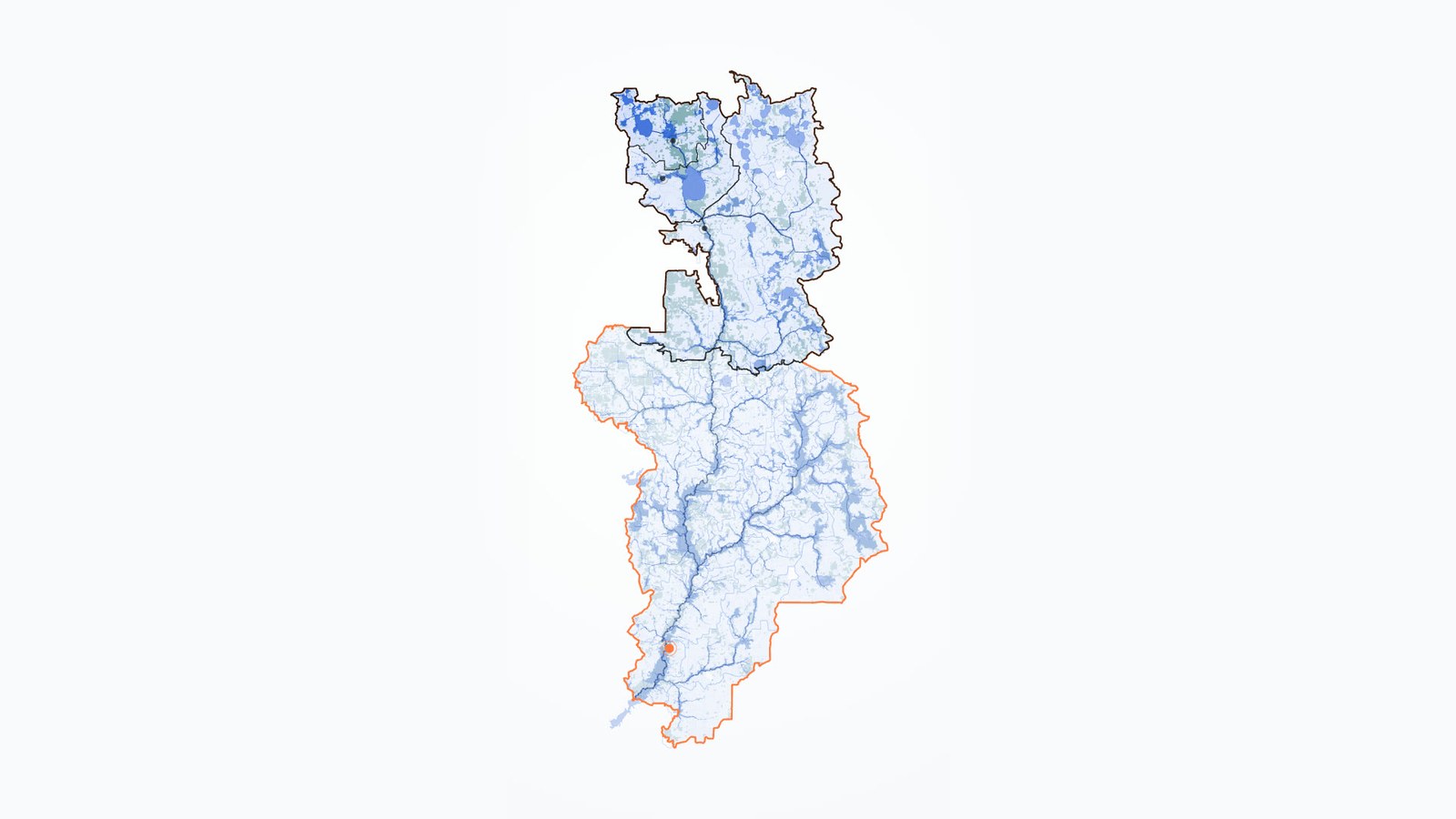
Model at a USGS gauge, a HUC12 outlet, or single HUC14 catchments you pick, with everything upstream if you choose.
See nested modeling →04 · SWAT+ / MODFLOW 6
A SWAT+ with MODFLOW order adds a steady-state MODFLOW 6 groundwater model, designed to take its recharge from SWAT+ (until that link is finished, a uniform default of about 200 mm/yr). Daily two-way coupling via BMI/XMI is research work. Inspect the models in 3D.
See coupled modeling →05 · PFAS fate and transport
06 · Public MCP server
Once you sign in: search models, query groundwater and PFAS inventories, preview builds — and, with your account, order and download SWAT+ packages.
See how to connect →07 · Open parallel SWAT+ engine
OpenMP wavefront on HRUs and channel routing. Byte-identical to serial on five basins at 1–16 threads with routing serial, and in both modes at 2–8 threads in the ship gate (v1.0-49); about five times faster at 16 threads on Peace River.
See engine benchmarks →08 · Automated cloud calibration
Calibrate SWAT+ against USGS streamflow on per-job EC2 instances — parallel MMPSO, live progress on the dashboard, charged at standard AWS rates.
See cloud calibration →Watershed science, end to end
Explore the public data. Connect Claude or Cursor over MCP. Create an account when you order a SWAT+ package.
Need larger allocations, coupling, or calibration? See access levels.
Flood and rainfall indicators on SWATGenX are for rapid triage and planning context, not a substitute for site-specific hydraulic studies, FEMA flood insurance studies, or official emergency warnings. For methodology and citations see Data & methodology. Account rules and data practices are in the Terms of Use and Privacy Policy.